10244
Published on December 31, 2025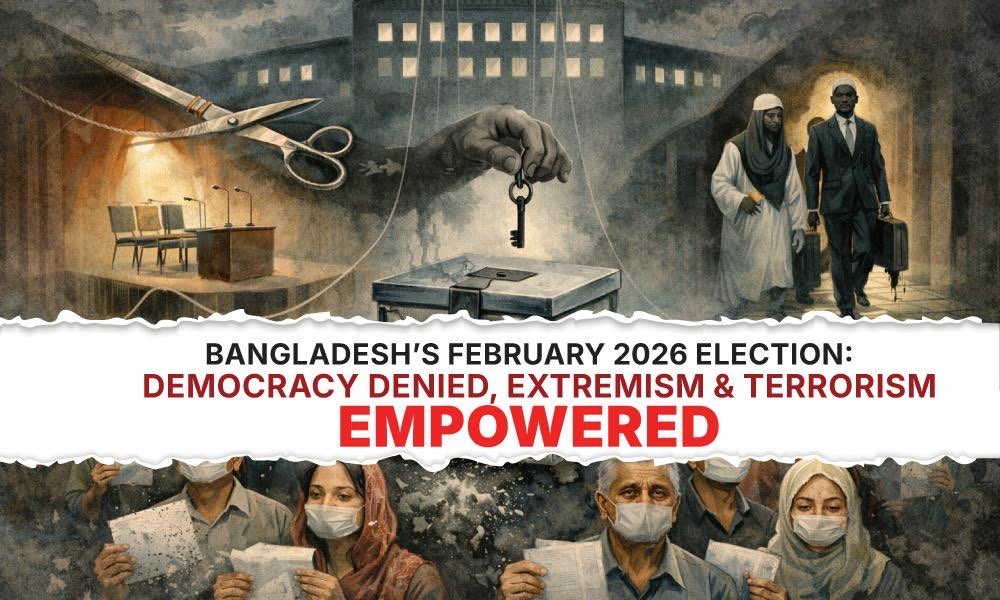
By banning the Awami League, the party of Sheikh Hasina, and suppressing the voices of millions of voters, the Yunus government paves the way for Islamist forces and criminalized leadership at the ballot box.
Bangladesh’s February 2026 election is being sold as a return to democracy, but in reality, it is built on exclusion. By banning the Awami League, the country’s largest political party with the support of nearly 60% of voters, the Yunus government has ensured that a majority of citizens will be locked out of the electoral process. An election that excludes the majority is not democratic; it is engineered.
The suspension of the Awami League’s registration by the Election Commission, followed by legal prohibitions under the Yunus administration, was not a neutral act of reform. It was a calculated political strike. Unable to defeat the Awami League in a free contest, the government chose to remove it altogether. This is not an electoral correction; it is mass disenfranchisement born of fear.
No credible democracy bans its largest political party and still claims legitimacy. Democracies compete; authoritarian systems eliminate rivals. By crossing this line, Yunus has turned the state into a political weapon and the election into a controlled exercise with a pre-decided outcome.
Voters are not being punished for crimes or corruption. They are being punished for who they support. Their ballots are rejected before they are even cast. When a government fears voters more than it trusts elections, democracy does not merely weaken; it collapses.
To defend the ban on the Awami League, the Yunus government repeatedly points to past elections as proof that Bangladesh’s democracy was already flawed. This claim does not survive basic scrutiny. During Sheikh Hasina’s tenure, across the 2014, 2018, and 2024 elections, not a single registered political party was banned. Every party retained the legal right to contest.
Where participation was limited, it was the result of political boycotts, not state-imposed exclusion. Choosing not to run is fundamentally different from being prohibited from running. Blurring that line is deliberate and misleading.
Foreign observers recognized this distinction. Even when opposition parties abstained, the electoral process remained legally open and competitive in principle. The state did not decide winners by removing opponents from the field.
That is the decisive contrast. Hasina permitted competition; Yunus is dismantling it. What is unfolding now is not democratic correction but democratic retreat, regression disguised as reform, driven not by principle but by political insecurity.
The decisive reason Yunus does not want the Awami League anywhere near the February 2026 election is simple and deeply troubling: its participation blocks the path to power for Islamist extremists and discredited criminal networks. Personal vendetta may exist, but it is not the strategy. The strategy is exclusion, because only by removing the Awami League can these forces realistically enter office.
For decades, Islamic extremist groups such as Jamaat-e-Islami have failed to win national mandates through free elections. Their ideology, historical record, and proximity to radicalism kept them electorally marginal whenever a strong secular alternative existed. With that alternative now forcibly erased, extremist politics is being normalized by default. Under Yunus’s watch, alliances involving Islamist actors are no longer treated as red flags but as acceptable political arrangements. This is how extremism enters institutions, not by winning public trust, but by exploiting engineered absence.
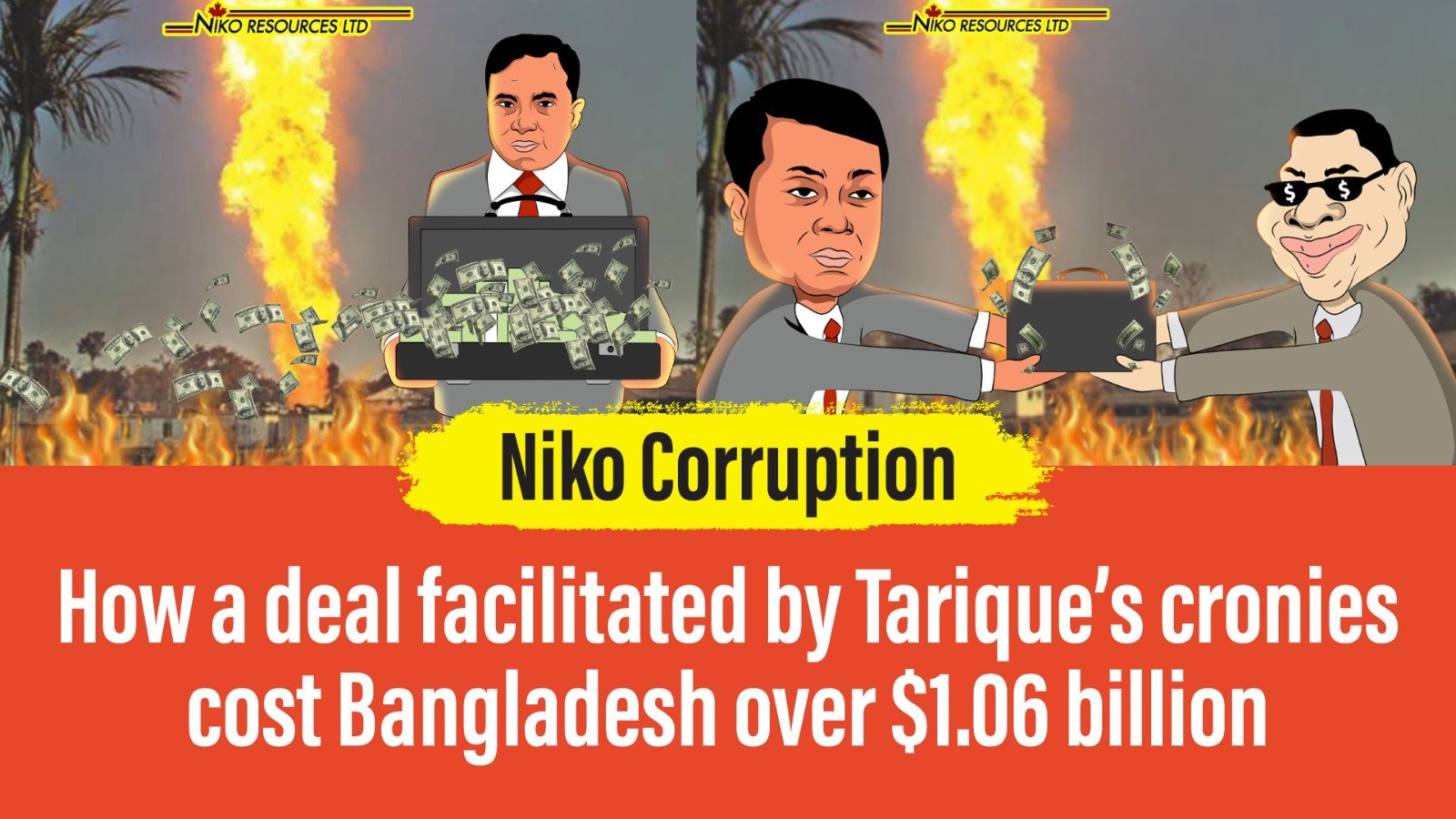
The same political engineering is visible in the rehabilitation of Tarique Rahman, a figure whose career is synonymous with corruption, arms trafficking, and financial crime. His association with the 10-truck arms haul, his links to militant networks, and long-standing allegations of large-scale money laundering made him politically toxic in any genuinely competitive election. When voters had a real choice, they rejected that brand of politics decisively.
Now, with the Awami League banned, that rejection no longer matters. Tarique is no longer competing against public judgment; he is benefiting from its removal. This is not a democratic transition; it is political laundering, where corruption and extremism are cleansed through controlled exclusion.
Yunus is not a neutral caretaker caught between rival forces. He is actively redesigning the political battlefield, removing the secular majority to elevate extremists and recycle criminal power. The result is a system where ideology hardened by extremism and wealth accumulated through corruption are rewarded, while popular support is treated as an obstacle to be eliminated.
When elections are stripped of real choice, the damage does not remain confined to the ballot box; it spreads outward, destabilizing the entire political system. History is unambiguous: elections without competition accelerate radicalization, legitimize political violence, and ultimately destroy public faith in voting as a tool for change. When people realize outcomes are pre-decided, ballots lose meaning and extremism fills the vacuum.
This is precisely the trajectory Bangladesh is now on. Overseas voters remain unheard, domestic voters are deliberately excluded, and secular political voices are systematically erased from public life. What emerges is not participation but alienation; not stability but resentment. A political system that shuts out millions does not produce consent; it manufactures anger.
The danger is not theoretical. Political exclusion has a pattern, and it rarely ends with moderation. By narrowing the political space and eliminating pluralism, Bangladesh risks drifting toward Taliban-style exclusionary politics, where legitimacy flows not from voters but from ideological dominance and coercive power. This is how democracies decay, quietly at first, then all at once.
The responsibility now extends beyond Bangladesh’s borders. The international community must not legitimize an election conducted on a rigged political field. Observation without inclusion is endorsement by silence.
An election without the Awami League is not democracy; it is democratic suicide, and the consequences will not remain contained within one nation.


This work is copyrighted and authorized by the Bangladesh Awami League. You may download, display, print and re-produce this material in unaltered form only (retaining this notice)for your personal, non-commercial use or use within your organization.
