3947
Published on January 31, 2026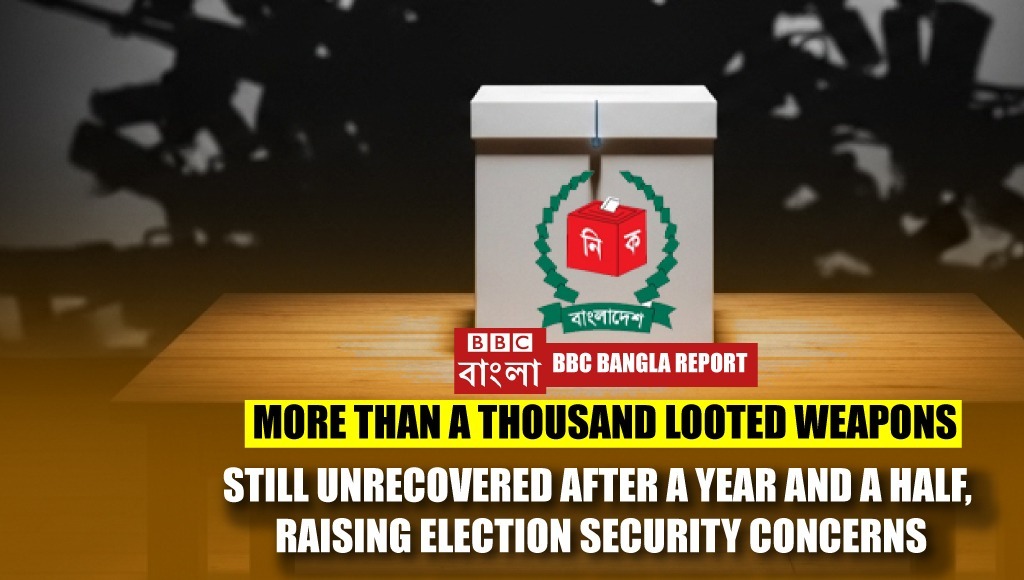
More than a year and a half after firearms and ammunition were looted from police during the July mass uprising in Bangladesh, law enforcement agencies have failed to fully recover them. Over one thousand firearms and more than two hundred thousand rounds of ammunition remain unaccounted for.
Security analysts warn that if these weapons are not recovered ahead of the upcoming parliamentary election, serious security risks could emerge.
Over the past 17 months, a joint force comprising the army and police has conducted multiple special operations to recover the missing weapons. The interim government has even announced cash rewards of up to five hundred thousand taka for information leading to the recovery of looted arms.
Despite these efforts, recovery has fallen well short of expectations. There are indications that many of the weapons have changed hands and ended up with criminal groups.
“All looted weapons should have been fully recovered within the past year and a half, but the interim government and law enforcement agencies have failed to do so. If the weapons are not recovered before the election, conducting a free and fair vote will be difficult,” said retired Major General A N M Muniruzzaman, President of the Bangladesh Institute of Peace and Security Studies, speaking to BBC Bangla.
Since the July uprising, the police force has failed to fully regain its footing. As a result, public dissatisfaction with the country’s law-and-order situation is growing.
Meanwhile, a series of shootings and killings ahead of the election has further heightened voter anxiety.
“In this situation, the government must clearly explain to voters how it plans to stop the use of weapons and ensure a secure election environment. Without reassuring voters on security, it will be difficult to bring them to polling centers,”
said election expert Dr. Abdul Alim to BBC Bangla.
During the July movement, public anger toward the police intensified due to their controversial role. Following the fall of the Awami League government on August 5, more than 450 police stations and outposts across the country, including in Dhaka, were attacked and looted.
Weapons belonging to the Special Security Force (SSF) were also looted from Ganabhaban, the Prime Minister’s official residence.
Initially, police reported that attackers looted around 5,500 firearms and approximately 650,000 rounds of ammunition.
However, in a recent meeting with the Chief Adviser, Army Chief General Waker-Uz-Zaman stated that the actual number of looted firearms was 3,619, along with 456,418 rounds of ammunition.
The looted weapons included Chinese rifles, various types of guns, submachine guns (SMGs), light machine guns (LMGs), pistols, shotguns, gas guns, and other firearms.
A joint army-police special operation to recover the weapons began in September 2024.
According to the Army Chief, 2,259 firearms have been recovered, accounting for about 62.4 percent of the looted weapons.
Additionally, 237,100 rounds of ammunition have been recovered, roughly 52 percent of the total looted ammunition.
In January, the government announced rewards for information leading to the recovery of the remaining weapons:
• 500,000 taka for an LMG
• 150,000 taka for an SMG
• 100,000 taka for a Chinese rifle
• 50,000 taka for pistols and shotguns
• 500 taka per round of ammunition
Many of the weapons and ammunition looted from police stations have reportedly been used over the past year and a half in robbery, extortion, armed theft, and even murder.
In April last year, two individuals arrested in Khulna on extortion charges were found with two police-issued pistols, a shotgun, and ammunition. Police stated that the suspects had been using the looted weapons in criminal activities.
Within months, police in Chattogram also recovered several looted weapons and rounds of ammunition, which had been used in robberies and muggings.
In November 2024, a woman named Shahida Akhtar was shot dead in Srinagar upazila of Munshiganj. Her body was recovered from a service lane of the expressway in the Dogachhi area. Investigators later confirmed that the murder was carried out using a pistol looted from Wari Police Station in Dhaka. Police subsequently arrested the killer and recovered the weapon.
“Looted weapons that have fallen into the hands of ordinary criminals are being used in robberies and extortion. But an even greater concern is that many weapons may have changed hands and reached extremist groups. If that happens, the law-and-order situation could face serious danger,”
said retired Major General A N M Muniruzzaman.
Former Inspector General of Police (IGP) Nurul Huda echoed the concern:
“Missing weapons are always a security risk, because it is impossible to be certain who has them and for what purpose they may be used.”
Security analysts say that this parliamentary election carries greater security concerns than previous ones.
“A major reason for this heightened anxiety is the weakened state of the police force. Ordinary people still do not fully trust them,”
said retired Major Emadul Islam, a security analyst.
Following the July uprising, police officers were attacked and killed in several areas due to their controversial role. This led to a breakdown in discipline and severely affected morale.
Although police returned to field duties after the interim government took power, the force has not fully recovered even after a year and a half.
“Because of the police’s weakened condition, the law-and-order situation has become fragile. With elections approaching, there is serious doubt over how effectively police will be able to perform,”
said Major General Muniruzzaman.
Of the 59 political parties registered with the Election Commission, 51 are participating in the election. The Awami League is barred due to its activities being banned.
“Despite being a major party, the Awami League’s exclusion from the election has angered its leaders and supporters. They may attempt to sabotage the election, which poses another major risk,”
warned Major Emadul Islam.
Analysts believe that the failure to recover all looted weapons has added a new dimension to election-related security risks.
“Despite repeated government appeals, a large portion of the looted weapons and ammunition has not been surrendered. This makes it clear that those holding the weapons do not have good intentions,”
said Major Emadul Islam.
“They will use these weapons for malicious purposes whenever they get the opportunity. The election period may be seen as such an opportunity.”
Several candidates have already been attacked. In December, Sharif Osman Hadi, a probable candidate for Dhaka-8 constituency and spokesperson of Inqilab Manch, was shot dead.
“Attacks on candidates and even on law enforcement personnel are sending a negative signal to the public about security,”
said former IGP Nurul Huda.
In response, the government has arranged security for many key candidates and issued firearms licenses to numerous individuals.
“However, many license holders do not even know how to properly use a weapon, increasing the risk of it falling into someone else’s hands. More importantly, arming candidates during an election effectively gives them leverage over their opponents. That is not a positive sign,” said Major Emadul Islam.
During the interim government’s 17-month rule, shootings and killings have continued to occur. According to the Human Rights Culture Foundation, at least 22 people have been killed and 137 injured in shooting-related incidents over this period.
Analysts say these developments have heightened voter anxiety.
“If people continue to feel unsafe during the election period, whether they will be willing to go to polling stations remains a serious question,” said election expert Dr. Abdul Alim.






This work is copyrighted and authorized by the Bangladesh Awami League. You may download, display, print and re-produce this material in unaltered form only (retaining this notice)for your personal, non-commercial use or use within your organization.
