8356
Published on June 24, 2026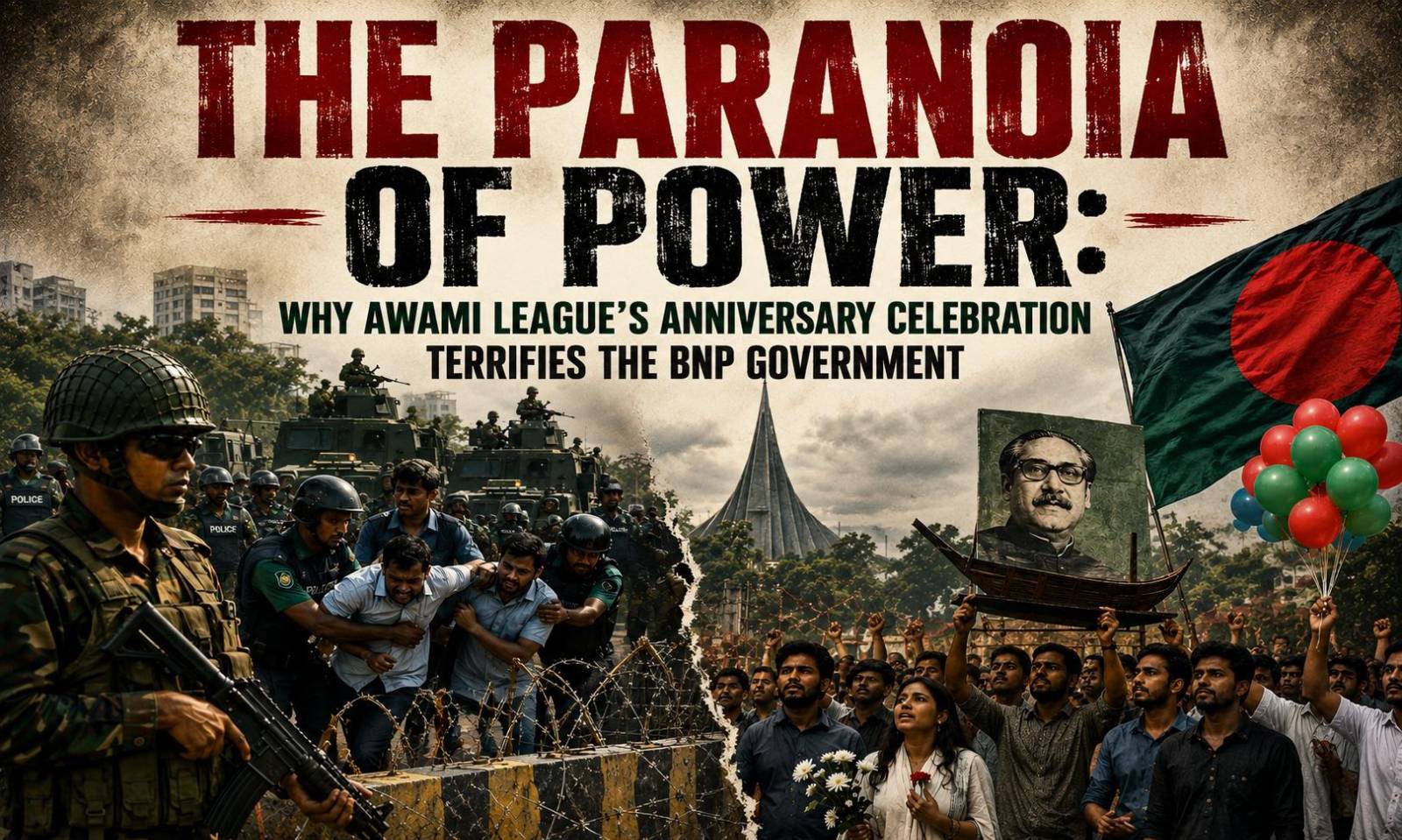
In what should have been a moment of peaceful reflection, Bangladesh witnessed a troubling display of state power on June 23, 2026. As the Bangladesh Awami League, the party that led the country to independence in 1971 and one of its most significant political forces, attempted to mark its 77th founding anniversary, the BNP-led government responded with extensive military deployments, widespread checkpoints, and numerous arrests. This raises serious questions about the state of democracy in Bangladesh.
The facts are damning. The government deployed the Bangladesh Army in Dhaka, Chattogram, Gazipur, Narayanganj, Gopalganj, and Faridpur until June 30. Border Guard Bangladesh (BGB) forces were mobilized in multiple districts. Dhaka alone saw around 18,000 police personnel unleashed, with over 200 checkpoints choking the capital. Special executive magistracy powers were handed to army officers of the Captain rank and above. Road No. 32 in Dhanmondi — hallowed ground linked to the party’s legacy — was barricaded like a war zone. Even journalists attempting to cover events were attacked.
Police intensified security measures and set up special checkpoints at key locations across Dhaka

In the 24 hours leading up to the anniversary, at least 112 Awami League leaders and activists were arrested across 16 districts. This is part of a broader wave: over 2,300 arrests in recent weeks, building on thousands already languishing in jails on fabricated charges or forced into hiding and exile. Flash processions, balloon releases, pigeon flights — simple symbolic acts — were crushed with brute force. The BNP’s message is unmistakable: even the whisper of Awami League activity is treated as an existential threat requiring the full machinery of the state.
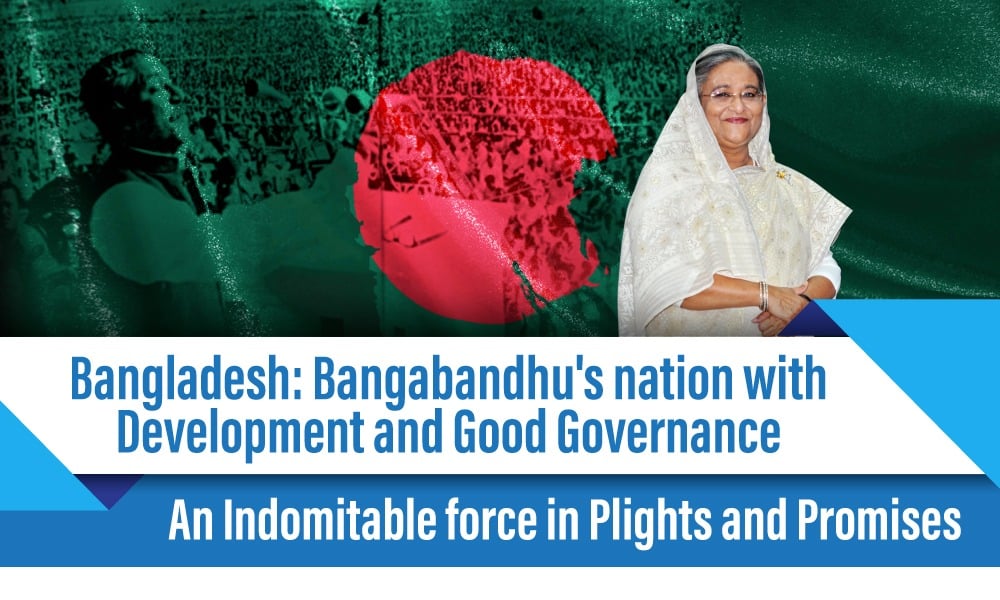
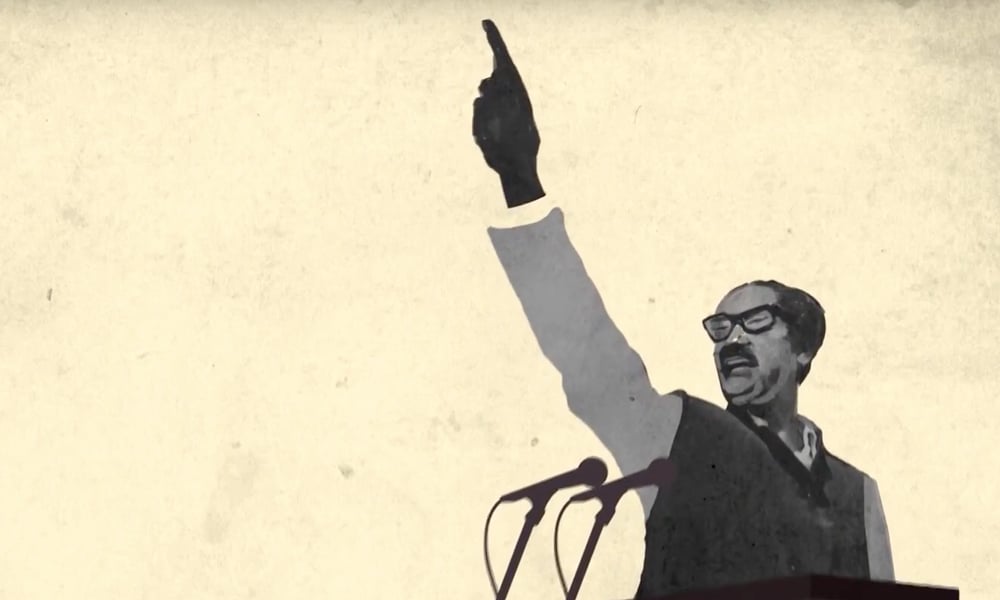
The Awami League is not a marginal faction. It is the party of Bangabandhu Sheikh Mujibur Rahman, the Father of the Nation. Under Sheikh Hasina’s leadership, it delivered transformative development: the Padma Bridge, Metrorail, nuclear power, digital infrastructure, and poverty reduction that earned global acclaim. Its deep roots in the Language Movement, Liberation War, and Bengali nationalism command enduring loyalty among millions. Yet the BNP government, propped up after the events of 2024, has banned the party’s activities, barred it from elections, and now deploys soldiers to prevent birthday cakes, processions, or posters.
This repression exposes a regime drowning in insecurity. Does the BNP genuinely believe that a party with thousands of its cadres imprisoned or suppressed still enjoys greater public support? Are they haunted by the prospect that allowing peaceful engagement would reveal their own shallow mandate and revive Awami League popularity? Or is this raw vengeance — a calculated campaign to decapitate the opposition and consolidate power through fear rather than consent?
In any functioning democracy, political parties mark anniversaries with rallies, debates, and outreach. They compete in the marketplace of ideas, not through military cordons and arbitrary detentions. What legitimate reason could possibly justify turning a national capital into an armed camp to stop a rival party’s peaceful commemoration? None. This is the playbook of dictatorships, not democracies. Home Ministry warnings of “sabotage” and “clashes” serve as convenient pretexts for a preemptive crackdown that burdens ordinary citizens, harasses families, and tramples constitutional rights.
The human toll is heartbreaking and infuriating. Mothers and fathers watch security forces raid homes. Young activists attempting quiet commemorations face batons and cells. Journalists documenting the repression are assaulted in places like Dhanmondi 32. This is the grim reality in a country that once hailed an “uprising” for democracy. The hollowness of that claim stands exposed under the weight of army boots and police barricades.
This is no isolated overreaction. It fits a larger pattern of selective repression. While the BNP and its allies operate freely, the Awami League — architect of modern Bangladesh’s progress — is demonized as a “mafia” and treated as a security threat. Intelligence reports are conveniently cited to justify extraordinary measures that would be unthinkable against other parties. The deployment of the army and the BGB, the granting of magistracy powers, and the nationwide alerts reveal a government that views democratic competition not as a strength but as a mortal danger.
International observers, human rights organizations, and democratic governments must confront this squarely. Deploying troops against citizens to block a political anniversary is the hallmark of fragile autocracies, not emerging democracies. It raises urgent questions about Bangladesh’s trajectory under BNP rule: Is this the “new Bangladesh” — one where state institutions are brazenly weaponized against a historic rival while the ruling coalition’s narrative dominates unchallenged? Where civil liberties are sacrificed on the altar of political vendetta?
The BNP’s paranoia inadvertently testifies to the Awami League’s resilience and lingering public resonance. A confident government secure in its legitimacy would allow open competition. Instead, by treating June 23 as a national emergency, the BNP has spotlighted precisely what it fears: the enduring spirit of a party that cannot be erased by force. History is littered with examples of repression backfiring — from Pakistan’s miscalculations in 1971 to countless failed attempts to silence popular movements.
Ordinary Bangladeshis deserve better than a political landscape defined by checkpoints, fear, and military intervention in civilian affairs. They deserve a system where anniversaries spark debate, not detentions; where parties earn support through governance, not suppression. The world is watching. International media, diplomats, and rights advocates cannot ignore this blatant assault on pluralism. Silence would signal acceptance of a dangerous precedent: the normalization of military-backed political exclusion under the guise of “law and order.”
The Awami League’s 77th anniversary, despite the iron fist, has become a powerful symbol of defiance and legitimacy. The party that birthed the nation refuses to be buried by fear. The real scandal is not the Awami League’s quiet commemorations, but a BNP government so terrified of democracy that it must militarize the streets to survive. Until this regime abandons its authoritarian playbook, Bangladesh’s promise of genuine freedom and accountable governance will remain a cruel illusion — choked by barricades and betrayed by those who claim to uphold it.








This work is copyrighted and authorized by the Bangladesh Awami League. You may download, display, print and re-produce this material in unaltered form only (retaining this notice)for your personal, non-commercial use or use within your organization.
