28633
Published on June 2, 2026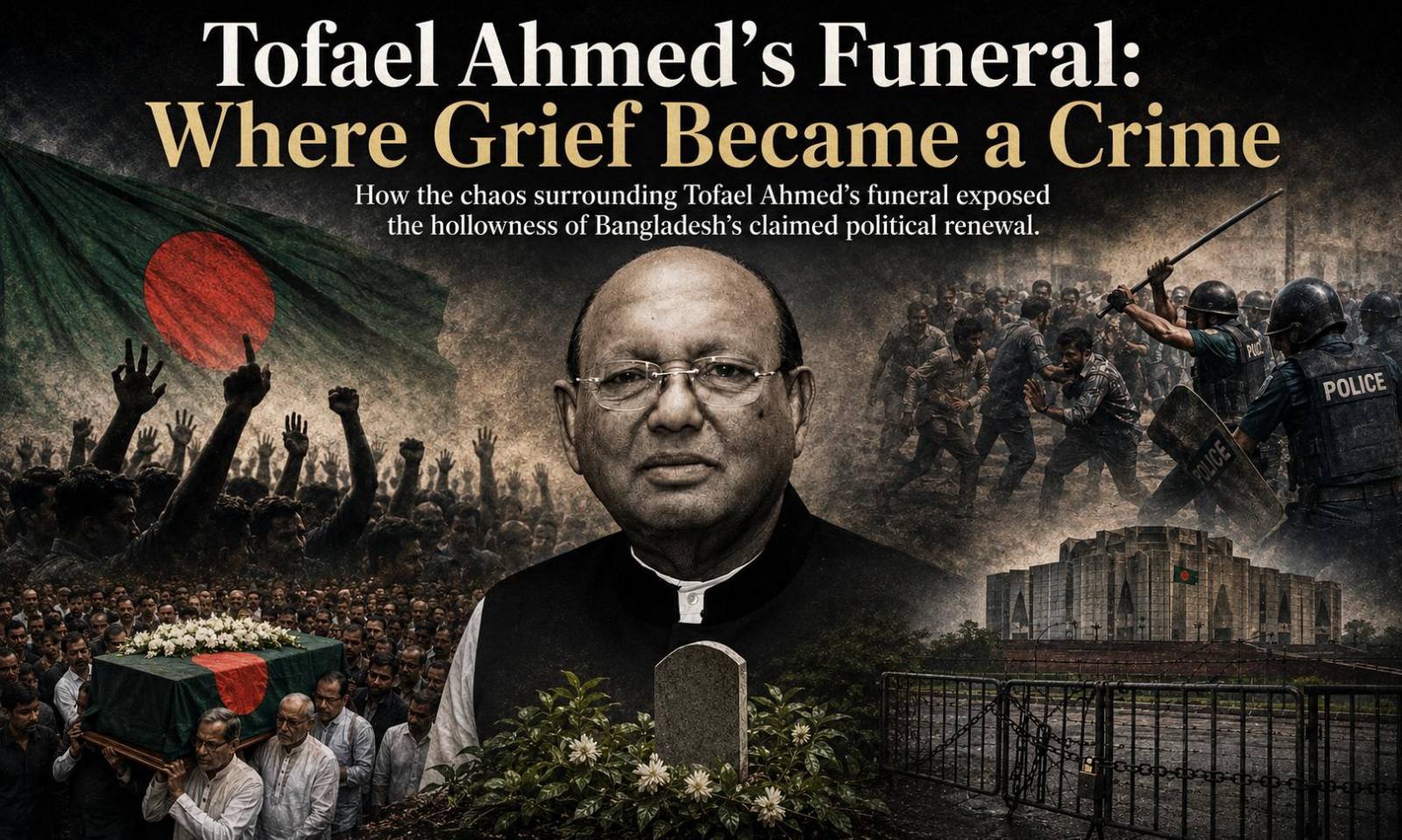
In a country that claims to be turning the page on vengeance, the final journey of Tofael Ahmed has become a stark indictment. The veteran Awami League leader, Liberation War organiser, and nine-time parliamentarian died on June 1, 2026. What should have been a dignified national farewell instead descended into confrontation, detentions, and allegations of deliberate obstruction.
Following the first janaza prayer in Dhanmondi, Dhaka, supporters chanted slogans, including the emotionally charged “Joy Bangla.” Police moved in swiftly. Several individuals were detained, and scenes of baton-wielding officers dispersing mourners quickly circulated. This was not a violent protest. It was the funeral of a man who had spent decades at the centre of Bangladesh’s political life. Yet even grief was treated as a potential threat.
The repression reportedly did not end in the capital. In Bhola, his ancestral home, authorities deployed heightened security measures and administrative restrictions, apparently aimed at limiting large spontaneous gatherings. Critics argue the intent was clear: to prevent ordinary citizens from turning the burial of a beloved local son into a powerful show of collective mourning.
This raises an uncomfortable question for the administration of Tarique Rahman: Can a nation that polices funerals and fears public grief truly call itself civilized, or "new"?
The irony is brutal. Tofael Ahmed once demonstrated the political maturity now so visibly absent. Despite fierce rivalries, he attended the funeral of BNP leader Sadeque Hossain Khoka, choosing basic human decency over partisan bitterness. Today, the same leader’s own death has been met with heavy-handed policing and accusations of orchestrated containment. The contrast could not be more damning.
Power, it seems, has a dangerous way of erasing memory. When a government feels compelled to control the mourning of even its historical adversaries, it reveals not strength, but deep insecurity. True political confidence does not fear tears or slogans at a graveside. It allows citizens to say goodbye without treating the dead as security risks.
For the international community, this episode should serve as a troubling signal. In the so-called “New Bangladesh,” basic humanitarian norms surrounding death appear negotiable. If a state cannot extend minimum courtesy to the mortal remains of a veteran national leader, what protections exist for the living who dare to disagree?
Tofael Ahmed’s disrupted final farewell forces a deeper reckoning: What kind of future is Bangladesh building, one grounded in dignity and restraint, or one where political vengeance follows a man even into the grave?



This work is copyrighted and authorized by the Bangladesh Awami League. You may download, display, print and re-produce this material in unaltered form only (retaining this notice)for your personal, non-commercial use or use within your organization.
