5501
Published on May 14, 2026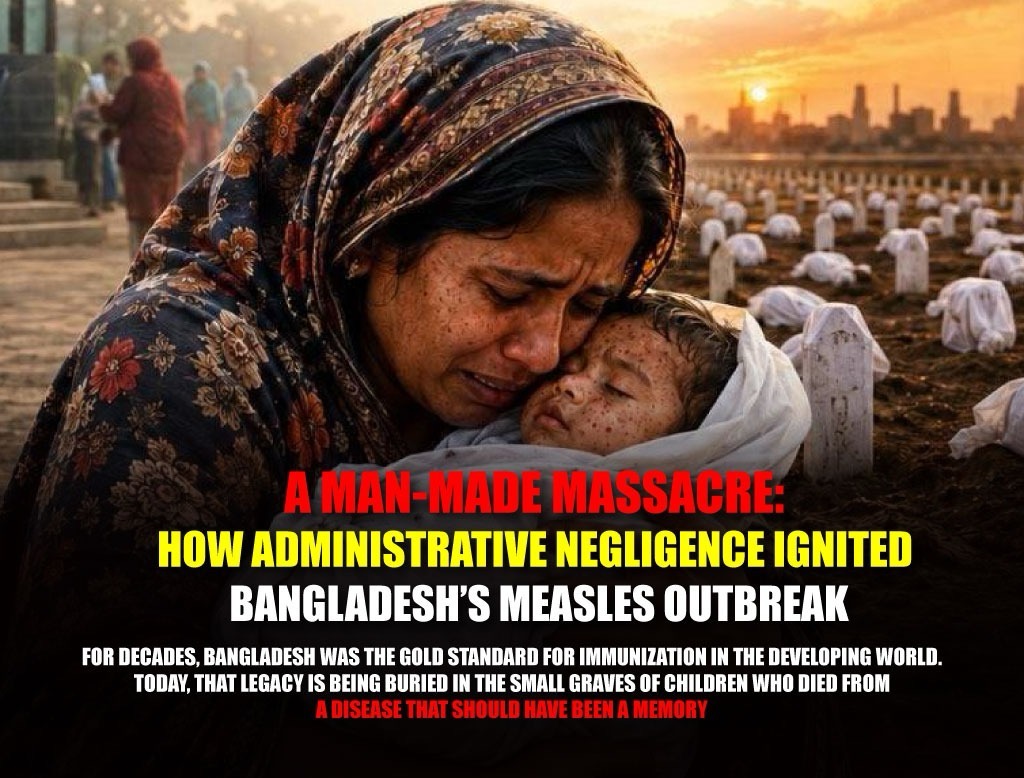
For decades, Bangladesh was the gold standard for immunization in the developing world. Today, that legacy is being buried in the small graves of children who died from a disease that should have been a memory.
For thirty years, Bangladesh served as the textbook example of how a developing nation could conquer infectious diseases. Its Expanded Programme on Immunization (EPI) was the crown jewel of its healthcare system. But in early 2026, that jewel didn't just crack; it shattered. What we are witnessing today is not merely a "surge" in cases; it is a full-scale health collapse that has left hundreds of children dead and millions at risk.
Measles explodes in Bangladesh after vaccination breakdown, killing hundreds of children
The tragedy is not that the virus is strong, but that the state became weak. The statistics emerging from Dhaka are not just numbers; they are an indictment. As of May 2026, the nation is witnessing a catastrophic resurgence of measles, a pathogen we were once on the verge of eliminating.
This is not an act of God, nor is it a mysterious viral mutation. It is a direct consequence of institutional paralysis and the catastrophic failure of the interim administration’s health leadership.
The Toll of Failure: Outbreak Summary (May 2026)
|
Outbreak Indicator (As of May 2026) |
Data/Status |
|
Total Suspected Cases |
47,000+ |
|
Laboratory Confirmed Cases |
6,989 |
|
Recorded Child Fatalities |
400+ |
|
Districts Affected |
58 out of 64 |
|
Primary Demographic at Risk |
Children aged 6 months to 5 years |
|
Vaccination Coverage Gap |
~4 million children missed doses (2024-25) |
The geographic spread is almost universal, affecting 58 - 61 out of 64 districts. The sheer speed of the transmission suggests a total breakdown of the "herd immunity" barrier that once protected the most vulnerable.
BGD: Epidemic - 05-2026 - Measles in Bangladesh
Over 400 Dead from Measles and Related Complications Amid Record Case Surge
Deaths from Measles and Related Symptoms Higher Than Official Figures
The outbreak’s explosion can be traced back to the July 2024 political transition that ousted Sheikh Hasina and installed Yunus’s interim administration. What followed was a self-inflicted wound on the country’s most vulnerable.
Measles Outbreak: ‘Interim govt ignored UNICEF warning.’
In September 2025, the Yunus government abruptly halted vaccine procurement through the reliable UNICEF channel, used successfully for years with Gavi support, and shifted to an open tender system. UNICEF representatives, including Rana Flowers, explicitly warned senior officials, including health adviser Nurjahan Begum, that this change risked severe disruptions and outbreaks. “For God’s sake … don’t do this,” Flowers reportedly pleaded. Those warnings were ignored.
"The vaccines were sitting in international warehouses, but the paperwork in Dhaka was stuck in a cycle of ego and incompetence. We told them in November 2025 that the shelves were empty. They told us to wait for the 'new system'." Anonymous Health Official.
Measles outbreak tied to procurement shift ignoring Unicef warnings
The predictable result: bureaucratic delays, nationwide stockouts, and plummeting coverage. A planned supplementary MR campaign was canceled. By 2025, only around 59% of eligible children received their measles vaccine according to government figures (later scrubbed from official sites). Stocks of critical vaccines, including measles, ran dry by early 2026. Herd immunity collapsed in a densely populated nation of over 175 million.
ACC Petition Seeks Probe into Yunus Government Over Alleged Vaccine Procurement Corruption
Experts for Legal Proceedings Against Interim Rulers Over Measles Epidemic
Measles is rarely lethal in a well-nourished population. However, the former interim administration failed to conduct the essential semi-annual Vitamin A supplementation rounds throughout 2025. Vitamin A is the critical shield against measles complications like pneumonia and brain swelling. By failing to distribute these supplements, the authorities at the time didn't just let children get sick; they ensured they were too weak to survive the infection.
Health experts, officials, and even legal complaints lay the blame squarely at the feet of the Yunus interim government (August 2024–February 2026). Key failures include:
Dr Yunus, Nurjahan blamed for child deaths linked to measles
Prof. Be-Nazir Ahmed and others have stated clearly: responsibility falls on the interim government for failing to maintain vaccination and herd immunity.
Preventable measles deaths: Who is to blame?
The Yunus administration inherited challenges, including post-revolution recovery. Yet excuses ring hollow when children pay with their lives for avoidable policy experiments. Defenders speak of building local capacity and reducing donor dependence, laudable in theory, criminal in execution when rushed without safeguards.
This tragedy demands answers. Who will take responsibility for these hundreds of preventable deaths? Who will hold the decision-makers, advisers, ministers, and the chief adviser himself accountable? Investigations by the Anti-Corruption Commission, parliamentary probes, and independent inquiries are essential. Families deserve justice, not condolences.
The new government has rightly reinstated UNICEF procurement and launched emergency vaccination drives targeting millions of children. Yet transmission continues. A full public health emergency declaration, accelerated campaigns, strengthened surveillance, and nutrition support are non-negotiable. International partners must scale up aid while Bangladesh rebuilds domestic resilience.
Bangladesh’s children were failed by those entrusted with their protection. Measles does not negotiate with bureaucratic inertia or political transitions; it exploits immunity gaps created by human failure. What happened here is a stark warning to the world: hard-won public health gains can evaporate overnight through negligence.
The dead children of 2026 cannot speak. Their parents’ grief must fuel national reckoning. Never again should political experimentation come at the cost of infant lives. The world is watching. Bangladesh must demand accountability, now, before more graves are dug for the innocent.







This work is copyrighted and authorized by the Bangladesh Awami League. You may download, display, print and re-produce this material in unaltered form only (retaining this notice)for your personal, non-commercial use or use within your organization.
