2902
Published on July 13, 2026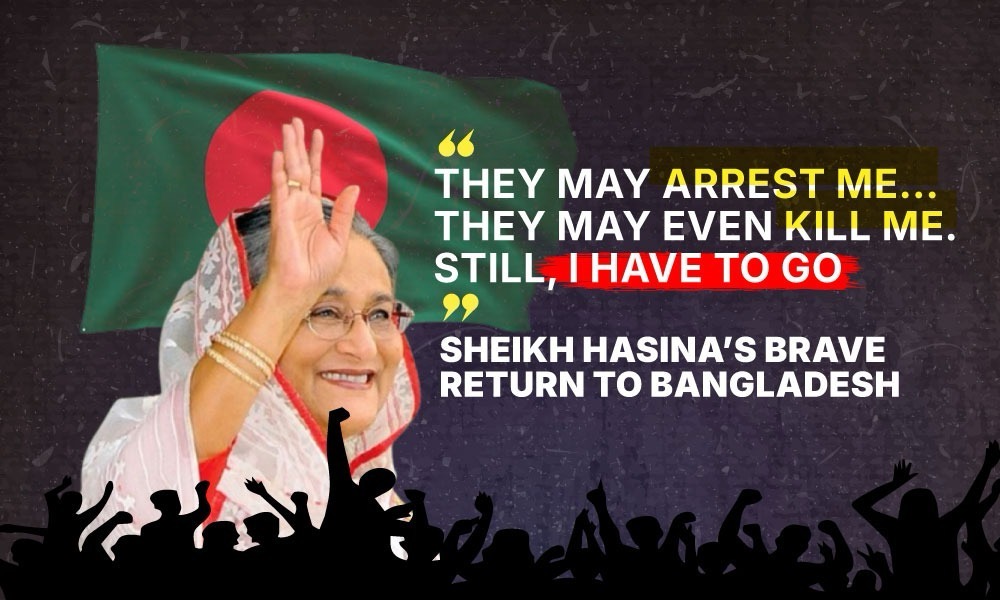
Former Prime Minister Sheikh Hasina’s sudden announcement that she will return to Bangladesh from her exile in India this coming December has sent shockwaves through Dhaka’s current political establishment. In an explosive exclusive interview with Reuters, Hasina stated plainly: “They may arrest me... they may even kill me. Still, I have to go”. But she laid down a high-stakes challenge to the ruling Bangladesh Nationalist Party (BNP) administration led by Tarique Rahman: she, along with senior Awami League leaders, will fly back to voluntarily surrender before the courts.
This is no desperate flight. It is a calculated act of courage from a leader who insists she has committed no crime. The charges of crimes against humanity, tied to the chaotic events of 2024, remain distant and contested. Sheikh Hasina denies ordering lethal force, and a fair process would expose the cases as fabrications designed to eliminate a rival rather than deliver justice. If Bangladesh possessed a genuine, independent judiciary free from external pressure, acquittal should be the outcome. Yet the current reality suggests otherwise.
The return of Sheikh Hasina now raises more than a few concerns - concerns that strike at the heart of whether Bangladesh under Tarique Rahman’s BNP government is capable of anything resembling justice or democracy:
Her voluntary surrender will force a direct, public trial that the state cannot easily control. If the courts function as a rubber stamp to convict her on fabricated charges without credible evidence, it will permanently expose the judiciary as a highly weaponized tool of executive retribution, destroying the regime’s credibility in the eyes of the international community.
The current administration’s grip on power relies heavily on keeping the opposition sidelined. Her presence on home soil threatens to completely shatter this fragile status quo, testing whether the state can maintain public order without reverting to brute force, arbitrary detentions, and open authoritarian crackdowns.
Despite two years of heavy-handed bans and systematic suppression, the Awami League's base remains deeply rooted. Her return acts as an immediate lightning rod for millions of supporters, presenting the very real threat of massive, uncontrollable political mobilization that could easily overwhelm an already anxious government.
If the regime denies her a fair, transparent trial, compromises her safety, or resorts to kangaroo court tactics, it faces immediate backlash from global democratic watchdogs and international trading partners. For a government already struggling with economic stability, the threat of diplomatic isolation and economic sanctions is a gamble it simply cannot afford.
This shifts the spotlight onto the state of Bangladesh’s institutions. Can the Tarique Rahman-led government actually guarantee a fair, transparent trial for Hasina and other Awami League leaders? Or will the judiciary function merely as an administrative rubber stamp for executive retribution?
For international observers, a trial conducted under the shadow of a partisan executive, amidst an ongoing ban on the country’s oldest political party, will carry zero credibility. If the current regime uses the courts to eliminate its primary opposition, it permanently forfeits its status as a democratic entity on the global stage.
The panic in Dhaka is palpable. The stark reality is that the current administration and its allied political factions are deeply afraid of Sheikh Hasina’s return. They know what local whispers confirm: despite two years of systematic crackdowns, asset seizures, and media censorship, the Awami League's grassroots popularity has not collapsed; it has surged. The public is experiencing a severe case of buyer’s remorse as economic instability and administrative overreach plague daily life under the BNP administration.
For Bangladesh to avoid collapsing into a one-party state masquerading as a reformed republic, the Tarique Rahman government must act with institutional maturity. It must fairly dismiss the politically motivated cases against Sheikh Hasina and immediately remove the ban on the Awami League. There is no alternative to this if Bangladesh is to ensure proper democracy.
International partners, democratic governments, and global trade bodies must look past the carefully curated public relations coming out of Dhaka. The true measure of Bangladesh’s democratic health will not be found in its official speeches, but in how it handles the voluntary return of its most prominent opposition leader. If the regime chooses arrest, kangaroo courts, or physical harm over genuine judicial integrity, it will prove that Bangladesh has not transitioned toward democracy; it has merely traded one form of authoritarianism for another.





This work is copyrighted and authorized by the Bangladesh Awami League. You may download, display, print and re-produce this material in unaltered form only (retaining this notice)for your personal, non-commercial use or use within your organization.
