20782
Published on May 3, 2026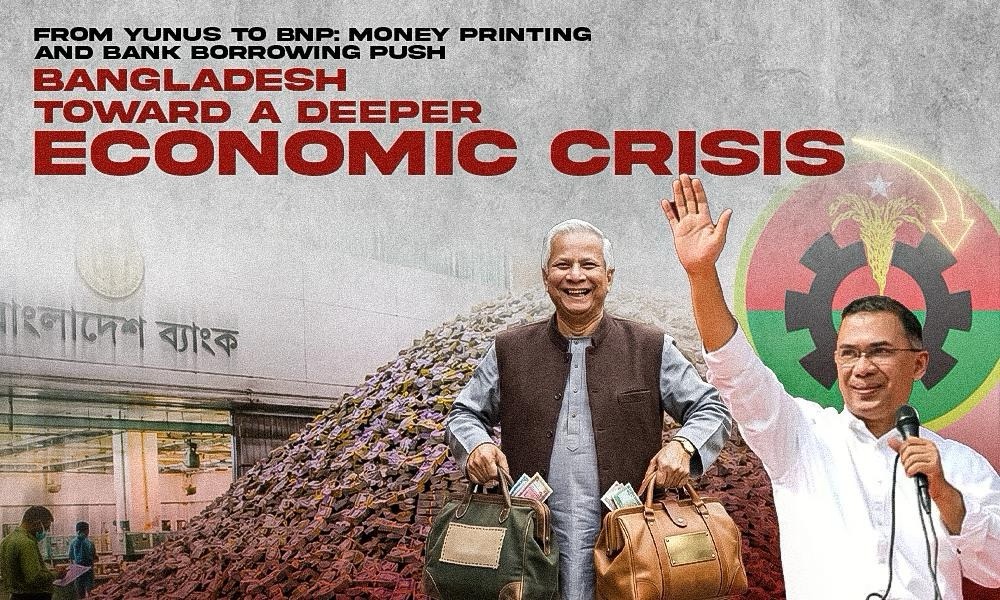
Bangladesh’s economy, once cited as a model of export-led growth, has entered a period of sustained financial stress following the violence of July-August in 2024. Since then, policy decisions taken under the Interim Government of Muhammad Yunus and subsequently the Bangladesh Nationalist Party (BNP) Government have combined to intensify inflation, strain the banking sector, and deepen fiscal vulnerabilities.
What is emerging is not a short-term disruption, but a structural imbalance driven by a combination of monetary expansion, aggressive domestic borrowing, and long-standing weaknesses in financial governance.
Inflation accelerated sharply during the tenure of the Interim Government led by Muhammad Yunus, crossing into double digits and remaining persistently high into early 2026. According to reporting by *Asia Times* and domestic economic analyses, food inflation has been particularly severe, driven by supply constraints, currency depreciation and rising import costs.
The Yunus administration’s policy environment—marked by fiscal pressure and administrative transition—coincided with a surge in price levels. Rather than easing, inflationary pressures have carried over into the BNP government period, where elevated food and energy prices continue to erode household purchasing power.
This persistence reflects deeper structural drivers. A weakening Bangladeshi taka has increased the cost of imports, especially fuel and essential commodities. At the same time, supply-side inefficiencies and energy constraints have limited domestic production response. The result is a sustained cost-of-living crisis, disproportionately affecting low- and middle-income households.
One of the most consequential policy choices came under the Interim Government of Muhammad Yunus: the expanded use of central bank financing to bridge fiscal deficits. This effectively meant increasing reserve money—commonly understood as “printing money.”
Reports indicate that Bangladesh Bank injected roughly Tk 200 billion into the financial system during this period to support government expenditure. The policy provided short-term liquidity relief but carried significant macroeconomic consequences.
In a fractional reserve banking system, such injections do not remain contained. They expand through the credit multiplier effect, increasing the broader money supply multiple times over. According to analysis published in *Prothom Alo*, each unit of reserve money can expand severalfold within the banking system.
The result has been a classic demand-supply imbalance: liquidity has increased rapidly, while production capacity has remained constrained. This mismatch has translated directly into sustained inflation and additional pressure on the exchange rate.
For households, the effect is indistinguishable from taxation. Inflation reduces real income and savings value, disproportionately affecting those without access to inflation-hedged assets.
Following the February 2026 election, the BNP-led government inherited a strained fiscal position and continued—if not accelerated—the reliance on domestic bank financing. Reports indicate that government borrowing from the banking sector surged toward Tk 100,000 crore and beyond within a short period.
Data cited by Prothom Alo suggests that total bank borrowing exceeded Tk 1.13 trillion within the fiscal year, reflecting both pre-existing deficits and new expenditure commitments under the BNP administration.
This strategy has significant macro-financial consequences. When the government absorbs large volumes of bank liquidity, it alters the structure of credit allocation. Banks, prioritizing sovereign lending due to lower perceived risk, reduce exposure to private borrowers.
The outcome is a crowding-out effect. Businesses—particularly small and medium enterprises—face tighter credit conditions and higher borrowing costs. Over time, this suppresses investment, slows job creation and weakens overall economic growth.
The BNP government’s reliance on bank borrowing reflects a deeper structural issue: Bangladesh’s low tax-to-GDP ratio limits fiscal flexibility. Without meaningful revenue reform, borrowing becomes the default mechanism for financing expenditure.
These policy decisions are unfolding within a banking system already under severe strain. According to reporting by *The Daily Star*, non-performing loans (NPLs) have surged to approximately Tk 6.4 lakh crore—around 35% of total outstanding loans.
This crisis predates both governments but has been exacerbated by current policy pressures. Years of politically influenced lending, weak regulatory enforcement and repeated loan rescheduling have eroded asset quality across the sector.
Under the Interim Government, attempts were made to initiate restructuring and consolidation within the banking system. However, these efforts remained incomplete. Under the BNP government, increased reliance on banks for deficit financing has added further stress to an already fragile system.
Liquidity constraints in weaker institutions, combined with deteriorating capital adequacy, have begun to undermine depositor confidence. In such an environment, even modest shocks can trigger disproportionate instability.
The interaction between fiscal policy, monetary expansion and banking sector fragility has created a self-reinforcing cycle.
Heavy government borrowing reduces liquidity available for private sector lending. To offset liquidity shortages, monetary authorities expand the money supply. This expansion fuels inflation, which erodes real incomes and savings, weakening financial stability further.
At the same time, inflation expectations begin to shift. Businesses raise prices in anticipation of higher costs, while workers demand higher wages to maintain purchasing power. This behavioral adjustment embeds inflation deeper into the economic system, making it more resistant to policy intervention.
Both the Interim Government and the BNP administration have operated within this constrained policy environment. However, the continuation of expansionary financing strategies across both periods has amplified rather than contained the underlying risks.
The BNP government now faces a narrowing policy corridor. Reducing inflation would require tightening monetary conditions and limiting deficit financing. Yet doing so risks slowing growth and exposing vulnerabilities within the banking sector.
Conversely, maintaining the current approach—reliance on borrowing and monetary expansion—risks entrenching inflation, weakening the currency and further eroding financial stability.
Stabilization will require coordinated action: restoring fiscal discipline, strengthening revenue collection, limiting central bank financing and undertaking credible banking sector reforms. Without such measures, the current trajectory points toward prolonged macroeconomic instability.
For Bangladesh, the challenge is no longer simply managing inflation or supporting growth. It is restoring confidence in economic governance—after a period in which successive policy choices, under two different governments, have collectively strained the system’s foundations.
Sources:
- https://asiatimes.com/2026/04/bangladesh-risks-new-inflation-surge-by-printing-money/
- https://en.prothomalo.com/business/local/1jqmnivgei
- https://www.thedailystar.net/business/economy/news/broken-trust-new-govt-faces-battle-clean-banks-4107061
- https://en.prothomalo.com/business/local/9maip1zyqf









This work is copyrighted and authorized by the Bangladesh Awami League. You may download, display, print and re-produce this material in unaltered form only (retaining this notice)for your personal, non-commercial use or use within your organization.
