4684
Published on January 22, 2026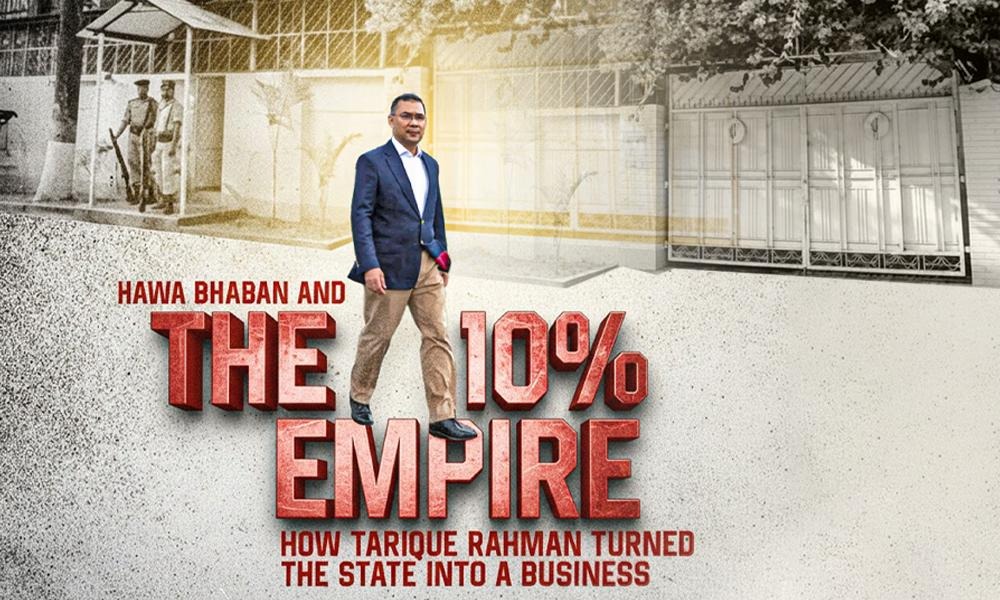
Today’s Bangladesh is witnessing a disturbing spectacle. Tarique Rahman is being celebrated, rehabilitated, and projected as a future leader, as if history has been erased, as if collective memory has failed. The crimes, corruption, and state capture of the 2001–2006 period are being deliberately forgotten, softened, or conveniently ignored. This amnesia is dangerous. Because what Tarique Rahman did during that time was not a footnote in history, it was one of the darkest chapters of institutional collapse in Bangladesh.
2001-06: How dangerous was Tarique Rahman?
Between 2001 and 2006, Tarique Rahman rose to absolute power without holding a single constitutional position. He was never elected by the people, never sworn in, never accountable to Parliament. Yet he functioned as the most powerful authority in the country. This was not democratic leadership; it was a dynastic seizure of the state.
The symbol of that seizure was Hawa Bhaban, an ordinary house turned into an extraordinary center of unlawful power. Hawa Bhaban did not merely influence governance; it overrode the Prime Minister’s Office itself. Policies, projects, postings, promotions, tenders, and business approvals were decided there. The elected government became secondary. The Constitution became irrelevant. The real state operated from behind closed doors, under the command of one unelected individual.
Tarique symbol of violent politics
Ministers queued at Hawa Bhaban for instructions. Bureaucrats understood that files meant nothing unless they carried invisible approval from there. Contractors knew that no government work, no matter how urgent or necessary, could begin without first paying allegiance and commission. Businessmen were forced to seek protection and permission not from institutions, but from a single man and his network.
As this parallel authority expanded, state institutions were systematically reduced to subordinates. Ministries lost autonomy. Regulatory bodies lost credibility. Law enforcement lost neutrality. Merit, rules, and procedures were replaced by loyalty, money, and fear. Governance was no longer about serving the people; it was about serving a syndicate.
What replaced the state was a system run by brokers, musclemen, and criminal networks. Decisions were auctioned. Power was monetized. Violence and intimidation ensured obedience. Hawa Bhaban did not just weaken the state; it converted the republic into a private enterprise, where influence was traded like a commodity.
Those celebrating Tarique Rahman today must answer one question:
How can a man who once turned the state into his personal business empire be presented as a national leader?
Before rewriting the future, Bangladesh must confront what really happened between 2001 and 2006, when Hawa Bhaban ruled, institutions collapsed, and democracy was held hostage.
The 10-Truck Arms Haul: Allegations Point to Tarique Rahman and Inner Circle
What operated from Hawa Bhaban was not random corruption; it was a system. A fixed, ruthless formula. During the 2001–2006 BNP period, a mandatory 10% commission became the unofficial tax on every government development project. This was not a rumor or exception; it was widely documented, openly discussed, and fearfully enforced. No commission, no work.
The Dark Prince and his Hawa Bhaban: Mountains of cash
Roads, bridges, power plants, ports, telecommunications, nothing moved without kickbacks. From small local contracts to mega infrastructure projects, the rule was the same: pay first, then work. Contractors were coerced into submission. Refusal meant cancellation, harassment, blacklisting, or worse. The message was clear: development was not about public need, it was about private profit.
This commission culture directly inflated project costs. Budgets were deliberately padded to absorb bribes. The result was predictable: substandard roads, fragile bridges, unreliable power supply, and poor-quality public works. Citizens paid twice, once through taxes and again through broken infrastructure. Public money was systematically looted, while accountability was deliberately dismantled.
How Hawa Bhaban Turned Business into a Mandatory 10% Commission System
At the center of this machinery stood Tarique Rahman. The scale and consistency of the extortion earned him a nationwide identity: “Mr. Ten Percent.” This was not a political slogan invented later; it was a label born out of lived reality during his reign of influence. When corruption becomes that uniform, that predictable, it stops being individual greed and becomes policy by practice.
Development under this system was reduced to a marketplace. Projects were traded, approvals were sold, and public service was replaced by profit calculation. The state did not ask what the people needed; it asked who paid and how much.
This is the legacy now being ignored. A man who institutionalized bribery, monetized development, and turned governance into a commission-based enterprise is being rebranded as a leader. But history is stubborn. And the 10% empire remains one of the clearest proofs that Tarique Rahman did not serve the state; he sold it.
The 10% commission culture did not stop at development projects; it spread across the entire economy, infecting banks, businesses, public institutions, and even law enforcement. Under Tarique Rahman’s shadow rule, economic governance was replaced by predatory extraction, where loyalty mattered more than law and connections mattered more than competence.
Banks were among the first casualties. Political pressure was routinely applied to force loan approvals for loyalists, cronies, and frontmen linked to the Hawa Bhaban network. Due diligence was ignored, collateral was waived, and risk assessments were overridden. The result was the deliberate creation of protected loan defaulters, individuals who borrowed huge sums, never repaid them, and faced no consequences because of political shelter. Overnight, ordinary criminals and party insiders became millionaires, while public banks absorbed the losses.
Corruption also penetrated public administration. Government jobs, postings, and promotions were effectively put up for sale. Merit was irrelevant. Competence was optional. What mattered was money and allegiance. Entire institutions, from the Public Service Commission to key regulatory bodies, were compromised, hollowed out, and converted into marketplaces where careers were bought and sold. The long-term damage to state capacity was devastating.
To enforce this corrupt order, criminal and violent networks were actively used. Musclemen controlled tenders, intimidated competitors, and collected extortion on behalf of political patrons. Violence was not an accident of the system; it was a tool of it. Fear ensured compliance, and impunity guaranteed silence. The line between politics and organized crime all but disappeared.
Tarique Rahman acquitted in money laundering case
As money poured in, illegal wealth accumulated at a scale impossible to explain by any lawful income. Large sums were siphoned abroad through money laundering channels, hidden behind businesses, proxies, and foreign accounts. While public resources were drained and institutions collapsed, Tarique Rahman settled into a life of comfort overseas, living in luxury, far from the consequences of the economic destruction he left behind.
Bangladesh paid the price: weakened banks, compromised institutions, lost public trust, and an economy scarred by corruption. Yet today, the architect of this looting is being repackaged as a leader. That contradiction is stark and unforgiving. A man who plundered the economy, protected criminals, and exported stolen wealth cannot be separated from the damage he caused, no matter how carefully his image is rewritten.
A statesman serves the nation; a corrupt politician exploits it. Tarique Rahman’s political record falls squarely in the second category. Leadership demands accountability, respect for law, and moral authority, qualities his career has consistently undermined.
When faced with legal scrutiny, Tarique Rahman did not stand before the courts. He stayed away, choosing absence over accountability. Absconding from justice is not a technicality; it is an admission of political and moral failure. A leader who will not face the law cannot claim to uphold it.
His identity is inseparable from multiple corruption and criminal cases rooted in the 2001–2006 period, cases that emerged from a system of parallel governance, commission-based decision-making, and protected criminal networks. These were not isolated accusations; they formed a pattern that defined an era.
At the heart of this pattern was dynastic entitlement. Power was inherited, not earned. Accountability was avoided, not embraced. The result was impunity, and impunity is the enemy of statesmanship.
A nationally known corrupt figure cannot represent national morality. No rebranding can erase the legacy of Hawa Bhaban.
Bangladesh needs leadership built on integrity, not the return of a culture that turned the state into a business.





This work is copyrighted and authorized by the Bangladesh Awami League. You may download, display, print and re-produce this material in unaltered form only (retaining this notice)for your personal, non-commercial use or use within your organization.
