4484
Published on January 19, 2026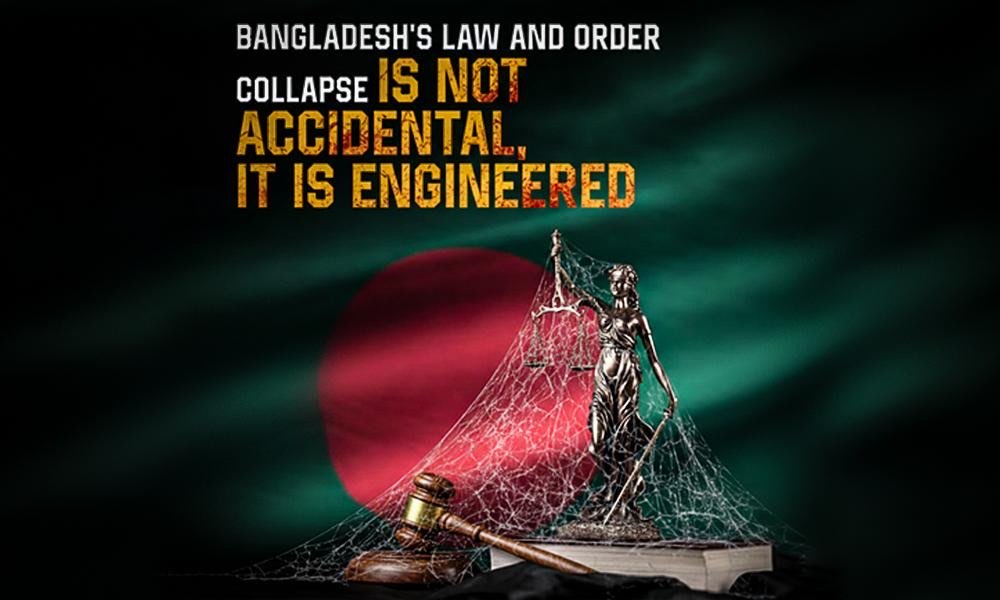
What is happening in Bangladesh today cannot be dismissed as disorder, coincidence, or administrative failure. The daily killings, the unchecked rape of women, the abuse and murder of children, the targeted persecution of minority communities, and the systematic burning of homes, businesses, and media offices are not isolated crimes. They are symptoms of a deeper, more disturbing reality. This is not chaos born of incompetence. This is chaos allowed, protected, and strategically sustained.
Bangladesh's Law and Order Crisis: A Failure of Leadership
Every single day, Bangladesh bleeds. And every single day, the Yunus-led system pretends this bleeding is accidental.
In 2025 alone, official reporting shows that an average of 11 people were murdered dailyacross Bangladesh — a figure higher than that of the previous two years.
Among these killings, over 100 were politically linked and occurred in highly publicized incidents tied to escalating tensions around the election cycle.
This isn’t a narrative of isolated crime — it is an escalating pattern with measurable data behind it.
1,930 Murders and 2,744 Rapes in Just Six Months: A Grim Picture of Law and Order
At the same time, women across the country are being raped with impunity. Not sporadically, not rarely, but consistently. The pattern is unmistakable. Survivors face police negligence, victim-blaming, intimidation, and endless delays. Perpetrators walk free, confident that the system will protect them. When rape becomes consequence-free, it stops being just a crime; it becomes a message. A message that the state will not defend women, that power outweighs justice, and that silence is safer than resistance. This is not a failure of law enforcement. This is the withdrawal of protection by design.
Children, the most defenseless members of society, are not spared. Child rape, torture, and murder appear in headlines with disturbing regularity, followed by predictable silence. No urgency. No outrage from the top. No sustained prosecution. A state that cannot protect its children has forfeited its moral legitimacy. When children are violated and discarded by the system, it exposes a government that no longer even pretends to uphold basic humanity.
Bangladesh’s child rape cases rise nearly 75% in 7 months
Minority communities are being targeted in ways that are neither accidental nor unfamiliar. Hindu homes are burned, temples vandalized, lands grabbed, and families displaced. Christian and Buddhist communities face intimidation and violence. Indigenous people are pushed further into insecurity. Each incident is brushed aside as a “local issue,” a “misunderstanding,” or outright denied. The pattern is clear: minorities are expendable, their suffering politically convenient. Their fear fuels polarization, distracts from governance collapse, and signals to extremist forces that violence will be tolerated. Silence from the state is not neutrality; it is complicity.
Arson has emerged as a preferred instrument of terror. Houses were reduced to ashes overnight. Businesses destroyed in minutes. Factories, shops, and media offices were set ablaze to punish independence and dissent. Economic destruction is not collateral damage; it is strategy. When livelihoods are burned, resistance is weakened. When the media is threatened, truth becomes dangerous. Fire becomes a language of power, and fear becomes its translator.
What makes all of this unmistakably political is the selective efficiency of the state. Law enforcement is not weak. It is highly capable when suppressing opposition, monitoring speech, dispersing protests, and arresting critics. The same efficiency disappears when it comes to rape, murder, minority violence, or arson. This selective blindness exposes the truth: the law is not absent; it is weaponized. Protection is reserved for power; punishment is reserved for dissent.
Bangladesh Records an Average of 11 Murders a Day in 2025
Documented data exposes just how political this violence has become. According to Ain o Salish Kendra, at least 401 incidents of political violence occurred nationwide between January and December 2025, resulting in 102 deaths. At the same time, police records show 3,785 murder cases across the country in a single year. These are not abstract figures — they reveal a state where politically driven violence flourishes while ordinary citizens are killed at scale, with neither deterrence nor accountability.
Bangladesh on the Brink: Destruction Under Yunus’s Grip
Anti-corruption bodies remain conspicuously silent. Human rights institutions issue hollow statements or none at all. Oversight mechanisms exist only on paper. The entire accountability structure functions not to protect citizens, but to shield the system. This is not governance; it is managed impunity.
The most dangerous lie being sold today is that the Yunus-led administration is “helpless” in the face of chaos. No government that can control narratives, suppress opposition, and consolidate authority is helpless. Disorder persists because it is useful. Chaos weakens social cohesion. Fear fragments resistance. Violence distracts from the absence of democratic legitimacy. When survival becomes the primary concern, citizens stop demanding accountability.
Human Rights Violations Persist Under Bangladesh’s Interim Government
This is where the meticulous design becomes visible. Instability is not an obstacle to power; it is its foundation. A frightened society is easier to rule than a united one. A bleeding nation is less likely to question authority. Lawlessness creates the excuse for authoritarian control, extended “temporary” arrangements, and the suspension of democratic norms. Violence becomes justification. Chaos becomes policy.
Information control plays a crucial role in sustaining this design. Data on killings, rape, child abuse, minority attacks, and arson are delayed, fragmented, or deliberately obscured. Journalists face pressure and threats. Reports are buried. Statistics are disputed without transparency. Truth is not debated; it is suppressed. This is why facts must be documented and shared before they disappear, because silence is the final weapon of this system.
The responsibility of citizens, journalists, and observers is not merely to react emotionally, but to record relentlessly. Every killing, every rape, every burned home, every persecuted family must be named, dated, and remembered. Because this violence is not happening despite the system, it is happening because of it.
Bangladesh today is not suffering from a lack of order. It is suffering from a lack of intent to protect its people. The Yunus-led arrangement did not arrive to reform, it arrived to control. And control, in this context, thrives on fear, blood, and silence.
When violence becomes daily, justice becomes selective, and accountability becomes optional, chaos is no longer a tragedy. It is governance by design.
And history will remember this period not as an unfortunate transition, but as a deliberate betrayal of the people.






This work is copyrighted and authorized by the Bangladesh Awami League. You may download, display, print and re-produce this material in unaltered form only (retaining this notice)for your personal, non-commercial use or use within your organization.
