7676
Published on December 8, 2025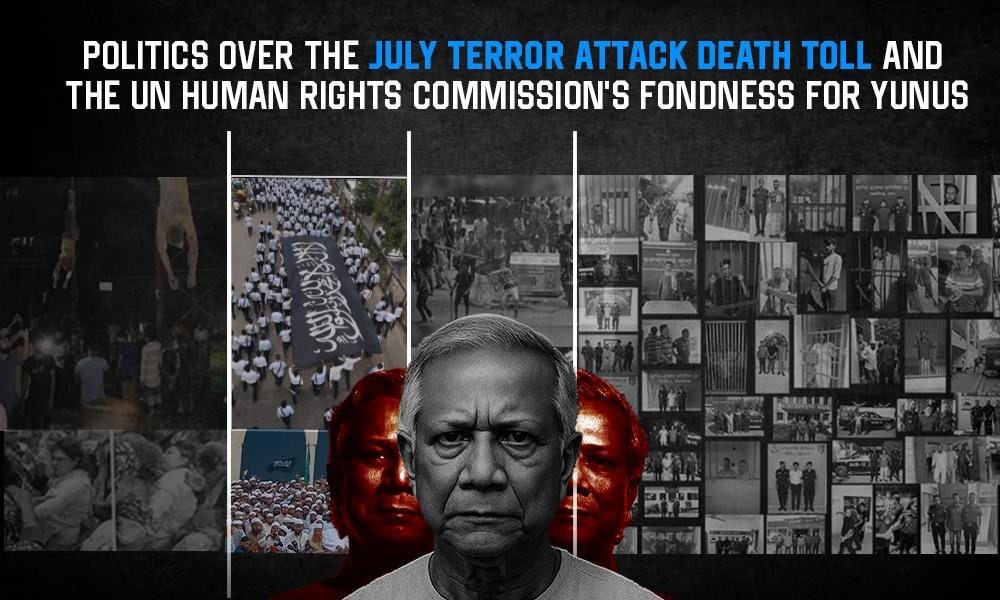
A fact-finding team from the Office of the UN High Commissioner for Human Rights (OHCHR) carried out a limited on-site visit between 16 September 2024 and 12 February 2025, and then released a report on the so-called July–August 2024 movement in Bangladesh. The report received major coverage in Bangladesh’s electronic and print media. Since the media in Bangladesh operates under censorship (whether enforced by the government, driven by fear of financial loss, or due to fear of attack in an environment of mob rule), only the parts of the report that went against Sheikh Hasina and her government were widely published.
The same bias appears in paragraph 227 of the OHCHR report:
“Since 5 August, many journalists and other civil society observers have perceived a climate of reverse intimidation, where journalists and media outlets are cautious about reporting anything that could be seen as favourable to the Awami League or critical of its political opposition.”
In other words, since 5 August many journalists and civil society observers have felt a reverse climate of fear, where media outlets remain cautious about reporting anything that might be considered supportive of the Awami League or critical of the opposition.
For the sake of truth, the Bangladeshi people need to know what else is inside the OHCHR report. Since the media has already highlighted everything that implicates the then Awami League government, it is better to focus on the remaining points.
The violence caused extensive loss of life. But the report also notes that not all of these deaths were caused by state forces. Various opportunistic groups were involved as well. Analyzing such deaths requires understanding the context of Third World countries. It should also be remembered that after the one-sided election held under the BNP government on 15 February 1996, at least 171 protesters were killed in just one month. Bangladesh also has to reckon with the presence of militant groups. There was no domestic militant involvement in 1996, but in 2024 there was. Pakistan-based Jamaat-ud-Dawa and Lashkar-e-Taiba have openly claimed they were active on the ground during the so-called 2024 movement. So it is more logical to call this a militant attack rather than a movement.
OHCHR estimates that between 15 July and 5 August 2024, the number of deaths linked to militant attacks was 1,400 (paragraph 58). The calculation is as follows: At the time of finalizing the report, the Ministry of Health had recorded 841 deaths. This figure is likely incomplete because medical staff were overwhelmed, causing many deaths and injuries to go unrecorded. Many families took bodies away without autopsy out of religious reasons or fear of reprisals for being associated with the protests. National Security Intelligence (NSI) recorded another 314 deaths not included in the Ministry’s data." (Paragraph 56)
If you add the figures from these two government bodies, the total becomes 1,155, not 1,400. The Ministry’s list was certainly not based on full postmortems. But is it believable that the families who allegedly collected bodies without autopsy did not report these deaths later, especially when a one-time grant of 3 million taka, a monthly allowance of 20,000 taka, and other benefits are available? The Awami League also provided the OHCHR with details of 144 party activists killed up to 15 August, including 58 killed by 5 August. These numbers were also not included. The TOR required numbers up to 15 August. Why then did OHCHR stop at 5 August?
The Ministry of Health now says the number is not 841 but 832. The government-run July Martyrs Foundation says the figure is 820. Yet investigative reports in the media show that among them are three people beaten to death in Jatrabari under accusations of rape. It is also learned that 35–40 of those listed as dead are actually alive. So why did OHCHR inflate the number to 1,400? The method they used to calculate deaths needs scrutiny. They relied mainly on the Health Ministry’s list and government statements instead of verifying information themselves. Even though 350–400 murder cases were filed, many were duplicate cases filed in multiple police stations, and even living persons were listed as dead. If 1,400 killings had occurred, the number of murder cases should be close to that. Bangladesh sees on average 300–350 murders per month. It seems unlikely that the OHCHR checked whether the regular July–August murder cases were added to the movement-related tally. Recently, the newspaper Prothom Alo reported that 61 names on the “martyr list” died from unrelated causes.
Almost all the deaths in the July–August militant attacks should have been caused by bullets. But the OHCHR report states:
“Forensic medical information provided by the Dhaka Medical College Forensic Medicine Department, based on its forensic examination of 130 deaths, indicates that more than three-quarters (78 percent) of all deaths were caused by firearms typically wielded by state security forces and not readily available to civilians in Bangladesh. Two percent by pistols and 20 percent by others” (Paragraph 61).
The report does not explain how that remaining 20 percent were killed. The Ministry of Liberation War Affairs released a list that mentions neither cause nor location of death. It doesn’t say whether police or anyone else fired. As a result, OHCHR relied on a very small sample of 130 bodies examined at Dhaka Medical College. Most bodies had no postmortem. The government wanted to conduct autopsies, but student leaders prevented it, which is also suspicious. Why didn’t the OHCHR advise the government to exhume bodies for autopsy? Should we then assume that OHCHR inflated the death toll and blamed all killings on the security forces, the Awami League, and the Chhatra League to further fuel public anger against Sheikh Hasina and her government?
The involvement of domestic and foreign militants is clear from their own proud admissions. Pakistan-based Jamaat-ud-Dawa and Lashkar-e-Taiba have openly claimed involvement. Interest groups even brought in Rohingya people. More than 111 unidentified bodies were buried in Rayerbazar and 20 in Jurain. Who were they? One year has passed, yet no more than 10 or 11 families have reported a missing relative. Were these bodies Rohingya or Pakistani militants? Long ago, following a High Court order, the government said it would exhume the bodies and conduct DNA tests so they could be identified later. But no steps have been taken.
After Sheikh Hasina left for India on 5 August, thousands attacked Jatrabari police station. According to BBC reports, more than 50 were killed when police opened fire in self-defense. A similar incident occurred at Ashulia police station in Savar. More than 450 police stations were attacked across the country, and many police and civilians were killed or injured. Can Sheikh Hasina, the Awami League, or the Chhatra League be held responsible for these killings? Yet the OHCHR report, without proper investigation and with clear intent, attributes almost all deaths to the police and other security forces, and also blames the Awami League and especially the Chhatra League.
The report itself states that among the first two deaths recorded at Dhaka Medical College during this violence, one was an Awami League supporter. Looking at the overall data, it appears that only a few dozen people died at the hands of security forces while protecting key installations, safeguarding lives and property, or restoring normalcy. The rest died either at the hands of attackers as part of their meticulous plan, or in police fire during unlawful attacks on stations. In Jessore, 26 people died when a rival militant group set fire to a hotel they were trying to loot. Their names have likely been included in the “martyr” list as well. There is no doubt that the OHCHR team inflated the death toll to please the Yunus government.
The absurdity continues: by repeating the UN’s fabricated claim of 1,400 deaths, attempts are being made to blame Sheikh Hasina and the Awami League, push them toward the International Criminal Court on the basis of doctored findings, and make them irrelevant in Bangladesh. For context, in Nepal, the recent student movement that toppled the government resulted in 71 deaths. Bangladesh’s population is eight times larger. By comparison, more people died in Nepal in just three or four days. Yet Nepal’s interim government is pursuing national unity instead of revenge. In Bangladesh, Dr. Yunus’s government is deepening division within the nation.


This work is copyrighted and authorized by the Bangladesh Awami League. You may download, display, print and re-produce this material in unaltered form only (retaining this notice)for your personal, non-commercial use or use within your organization.
