6341
Published on December 3, 2025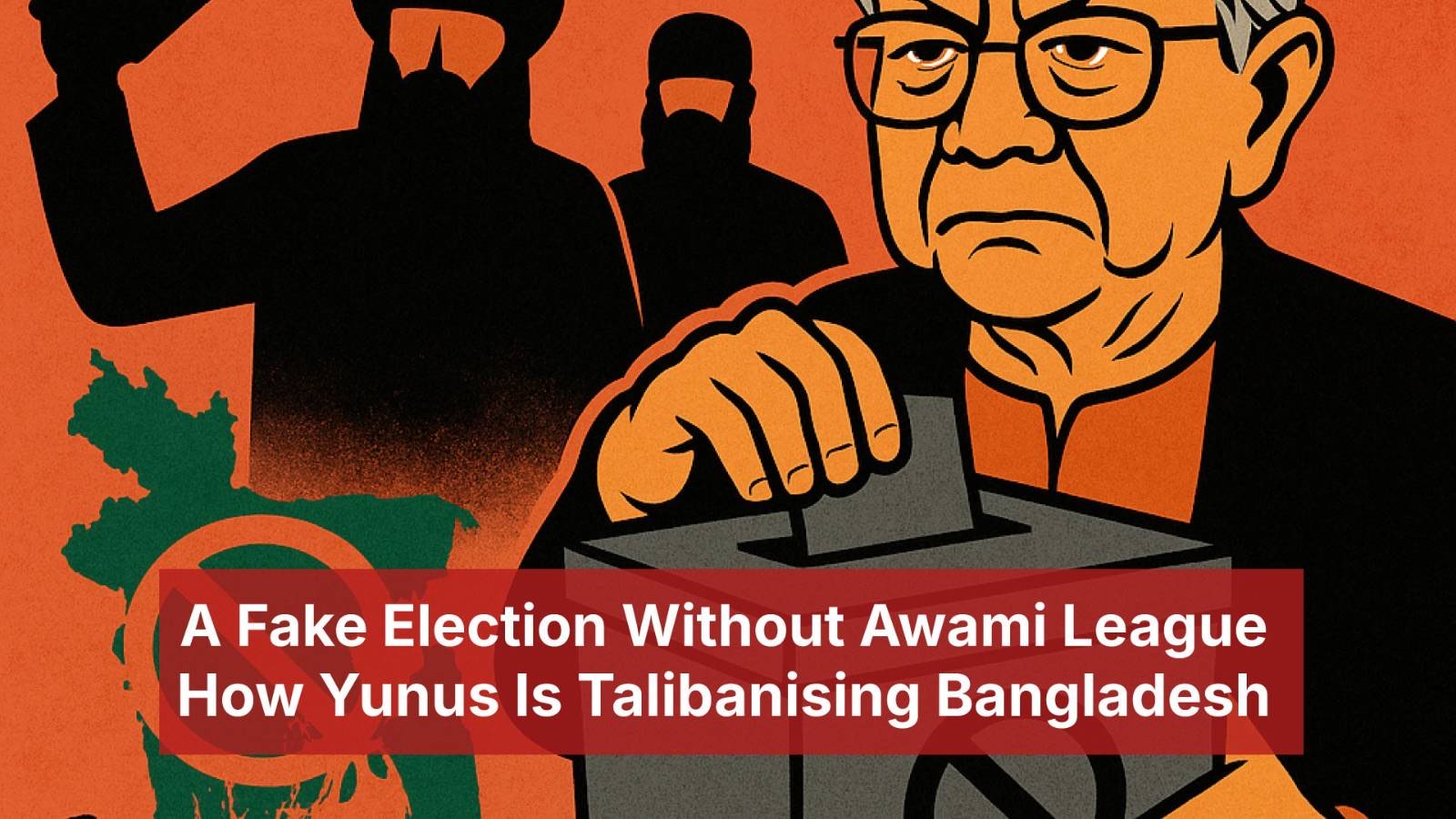
Bangladesh is entering one of the most unsettling periods in its recent history. What should have been a transitional moment has instead become a slow-motion dismantling of our democratic foundation. Since taking charge in August 2024, Muhammad Yunus has made one decision that changed everything: he suspended all activities of the Awami League, effectively blocking nearly 40% of the country’s voters from taking part in the next election.
With that single order, the upcoming poll stopped being a national election and became something else entirely, a carefully staged exercise designed to keep real competition out.
Bangladesh Faces Risk of Talibanisation Under Yunus Government
This isn’t an accident or a misunderstanding. It’s a clear pattern. As the country’s largest political force is pushed aside, groups like Jamaat-e-Islami and Hefazat-e-Islam are getting a level of space and influence they haven’t enjoyed in years. At the same time, attacks on women’s rights, growing pressure on minorities, and “moral policing” in public life are becoming disturbingly common.
Bit by bit, Bangladesh is being steered toward a direction that feels alarmingly familiar, a softer, quieter version of Talibanisation, carried out not by radicals on the streets, but by decisions made at the very top of the state.
Talibanisation Of Bangladesh Gets Real
When Yunus suspended all activities of the Awami League, it wasn’t just an administrative decision; it was a political blackout unprecedented in Bangladesh’s history. With a single executive order, he managed to silence the country’s largest political force and effectively shut down the voices of nearly 40% of the electorate. No debate. No due process. No public mandate. Just raw, unchecked power.
Bangladesh bans activities of Awami League
This is exactly the kind of tactic used by regimes that fear genuine competition. In Afghanistan, the Taliban neutralized opposition not by winning public trust, but by banning rival parties, restricting political organising, and isolating communities who refused to accept their rule. Yunus may not be enforcing his will with guns, but the method is eerily similar: erase the opposition, then declare the political landscape “open” for controlled actors.
By sidelining the Awami League, Yunus has attempted to engineer a political environment where the outcome of the next election is predetermined. It is a move that mirrors authoritarian logic; if you can’t defeat your opponents, you simply remove them from the field.
Awami League can't take part in national election: Yunus tells UK minister
And the consequences are profound. When 40% of the population loses its ability to participate, the election becomes meaningless. Democracy becomes theatre. And the state starts to look less like a pluralistic republic and more like a system shaped by the same anti-democratic instincts that define Taliban-style governance: concentrate power, silence opponents, and reshape society without consent.
This executive order wasn’t just an attack on a political party; it was an attack on the very idea of democratic choice. And it marks one of the clearest signs yet, that Yunus is steering Bangladesh toward a political model that has more in common with authoritarian Islamist regimes than with the secular, democratic nation its people have always fought to protect.
As Yunus pushes millions of voters out of the democratic process, he is pulling in the very forces Bangladesh has long fought to contain. Lacking public support, he has turned to Jamaat-e-Islami, Hefazat-e-Islam, and other extremist networks as his new political base. These groups, once restricted for violence and radical agendas, are now enjoying fresh legitimacy, freedom, and protection in exchange for mobilizing support for Yunus.
How Yunus Embraced Islamist Extremists In Bangladesh
Inside the state, the shift is unmistakable. Secular administrators are being purged, while Islamist-friendly actors rise into key positions. Law enforcement seems far more interested in chasing AL supporters than in monitoring the radicals who once targeted minorities, women, and cultural institutions. The power equation is clear: the state is being reshaped to suit Yunus’ extremist allies.
And the social consequences are already visible. Attacks on secular media, cultural spaces, academics, and women’s rights are increasing. Cancelled women’s sports, moral policing, and pressure on institutions to follow Hefazat-style norms show how radical ideas are creeping into everyday life.
ISI’s Bangladesh Blueprint: Jamaat and Hefazat Push for Talibanisation
This is how Talibanisation takes root, not with a single dramatic moment, but through a steady alliance with extremists, the quiet capture of state machinery, and the slow erosion of social freedoms. Yunus is not just tolerating radical forces; he is empowering them, and Bangladesh is beginning to look alarmingly like a nation being steered toward a Taliban-style future.
By banning the Awami League from contesting, Yunus has turned the next election into a manufactured ritual. With the largest political force removed, the outcome is fixed, paving the way for an Islamist-influenced order built through a ballot that means nothing. This is the Taliban model in practice: elections held for appearance, power decided in advance.
The cost is enormous. Bangladesh’s secular identity now hangs by a thread. As extremist factions gain political ground, the country faces rising intolerance, shrinking freedoms, and a growing threat to minorities. The instability doesn’t stop at our borders; it undermines regional security and damages Bangladesh’s international standing.
Yunus has pushed the nation to a dangerous edge. What’s coming is not just a flawed election, it’s the quiet construction of a Taliban-style state, engineered through exclusion, fear, and a rigged political process.

This work is copyrighted and authorized by the Bangladesh Awami League. You may download, display, print and re-produce this material in unaltered form only (retaining this notice)for your personal, non-commercial use or use within your organization.
