5412
Published on November 24, 2026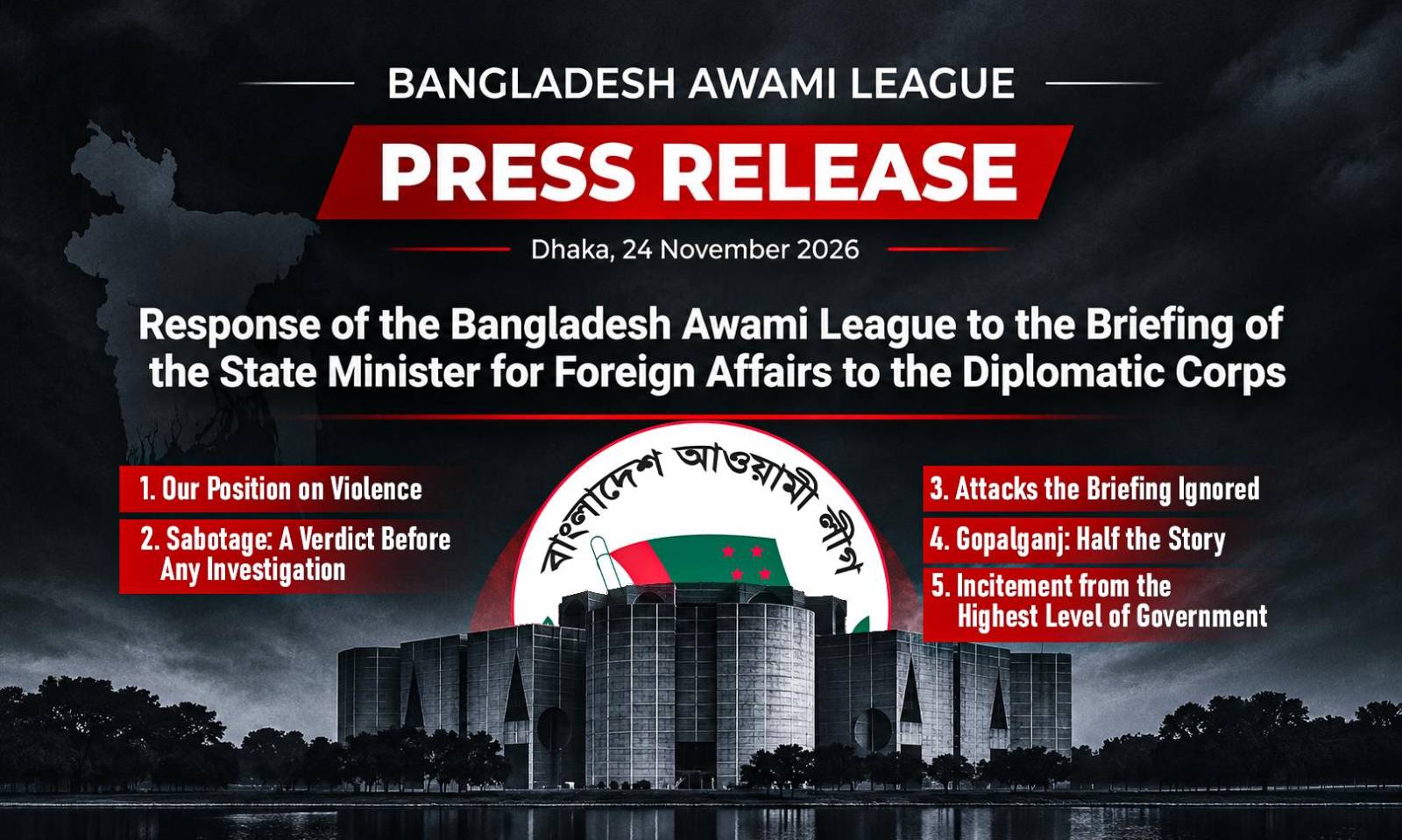
BANGLADESH AWAMI LEAGUE
PRESS RELEASE
Dhaka, 24 November 2026
Response of the Bangladesh Awami League to the Briefing of the State Minister for Foreign Affairs to the Diplomatic Corps
The Bangladesh Awami League has reviewed the remarks made by the State Minister for Foreign Affairs, Mr Humaiun Kobir, at his recent briefing for the diplomatic corps. In our view, the briefing was factually incomplete, stripped of context and one-sided, and it was designed to mislead the international community. We reject it, and we ask our international partners to consider the following.
1. Our Position on Violence
The Bangladesh Awami League condemns all violence, arson, destruction of property and attacks on law enforcement personnel. We extend our deepest condolences to the families of everyone who has lost their life, including the bus driver killed in Faridpur, and we wish the injured members of the Border Guard Bangladesh and the police a swift recovery. Every crime must be impartially investigated and prosecuted. However, branding millions of a political party's supporters as "terrorists" before any investigation has taken place is incompatible with the rule of law.
2. Sabotage: A Verdict Before Any Investigation
Attacks on Grameen Bank or any other financial institution, on vehicles, or on the property of ordinary people are unacceptable. The briefing stated that between 7 and 19 November, 83 vehicles were set on fire, crude bombs exploded at 87 locations, and 72 Grameen Bank branches or offices were attacked. Yet the Minister's own figures show that only 39 cases were filed and 66 people arrested in that period. In most incidents, therefore, the perpetrators have not even been identified. Even so, every incident has been blamed on the Awami League without any investigation.
Bangladesh has seen this pattern before. Between 2013 and 2015, during strikes and blockades enforced by the BNP and Jamaat-e-Islami, many innocent people were burned to death in petrol-bomb attacks on passenger buses, crude-bomb blasts and arson. Today's incidents follow the same pattern: vehicles set alight, crude bombs and highway blockades. Given this history, the possible involvement of those groups, or of elements they support, cannot be ruled out.
The question must be asked: who benefits? Since Sheikh Hasina, former Prime Minister and President of the Bangladesh Awami League, announced her return, party members across the country have been mobilising. At exactly this moment, every act of sabotage is being attributed to the Awami League, the diplomatic corps is being briefed on that basis, and harsher crackdowns are being announced. We believe the aim is to lay the groundwork for further repression and to legitimise it internationally. Every incident therefore requires an independent investigation. That investigation must also examine the possible involvement of the BNP and Jamaat-e-Islami, and the possibility that some incidents were staged.
3. Attacks the Briefing Ignored
The briefing listed 158 incidents between 1 and 21 November but did not mention a single attack on Awami League members.
On 20 November, a mob rampaged through Bendarchar in Kalia, Narail district, from the afternoon until midnight. Police put the number of damaged homes at 15 to 20, but BBC Bangla, reporting from the scene, counted at least 60 to 70 homes and shops burned or destroyed. More than 150 families were affected.
Within a single week, homes, shops and offices belonging to Awami League members were attacked or set on fire in at least 13 districts: Narail, Sirajganj, Patuakhali, Barguna, Dinajpur, Netrokona, Jhalakathi, Mymensingh, Rajshahi, Chattogram, Feni, Brahmanbaria and Dhaka.
The Narail Superintendent of Police acknowledged that members of the ruling party took part in the attack, yet no arrests have reportedly been made. The fire started at around 4 pm, but the fire service arrived only at 8 pm.
4. Gopalganj: Half the Story
The briefing highlighted incidents at the Tungipara police station on 17 November and the Muksudpur police station on 19 November. The Awami League does not condone arson, the looting of weapons, or attacks on the homes and offices of elected representatives, and we call for those responsible to be brought to justice. However, presenting these events without their context is misleading.
On 16 July 2025, five people were killed in Gopalganj. According to a fact-finding investigation by the human rights organisation Ain o Salish Kendra (ASK), five civilians were shot dead by law enforcement. ASK described the events as a serious violation of human rights. The victims were Ramzan Kazi, a mason; Sohel Rana, a mobile phone parts trader; Dipto Saha, a shop owner; Imon Talukder, aged 17; and Ramzan Munshi, an auto-rickshaw driver.
Video footage showed soldiers and police opening fire, yet no one has accepted responsibility. The families were pressured into burying or cremating the victims without post-mortem examinations. Instead, police filed murder cases against 5,400 unnamed people and arrested more than 300, including 18 children. More than a year later, no one has been held accountable for these killings.
This month, a single case in Gopalganj named 2,224 people as accused. On 17 November, after further arrests, police opened fire on people who had gathered outside the police station. The briefing made no mention of this. Every avenue for peaceful assembly has been closed, there has been no justice, and thousands are charged after every incident. When the state pushes people to the wall, the primary responsibility for the resulting unrest lies with the state.
5. Incitement from the Highest Level of Government
The briefing claimed that the government will not tolerate retaliatory violence. Yet on 18 November, in his closing address to the Jatiya Sangsad (National Parliament), Prime Minister Tarique Rahman called the Awami League a terrorist group rather than a political party. He said it must not be allowed to rise again and declared that "before that happens, we want to crush them again in the spirit of 2024."
That same day, Awami League offices and the homes of former ministers, former members of parliament, and central and local party leaders came under attack and were set on fire in Sirajganj and other districts. Within five days, at least 108 homes of Awami League leaders and supporters were targeted across the country.[1] Two days after the speech came the rampage in Bendarchar, Kalia, where homes and businesses were attacked, looted and set ablaze.[2][3] In Keraniganj, a mob led by Chhatra Dal vandalised and looted the home of an Awami League leader.[4] Statements of this kind from the head of government lend legitimacy to violence on the ground.
6. Banning a Political Party by Executive Order: The Constitutional Question
The Awami League was not banned by any court. The ban was imposed through an ordinance and an executive notification before any trial had concluded. As a result, a large section of the population has been deprived of political representation and of the right to vote for the party of its choice. This violates Article 38 of the Constitution of Bangladesh, which guarantees freedom of association. It also violates Articles 14(2), 22 and 26 of the International Covenant on Civil and Political Rights (ICCPR).
Amnesty International has stated that the ban brought into question their commitment to upholding freedom of association. In a letter to the government dated 29 December 2025, UN Special Procedures mandate holders, including the Working Group on Arbitrary Detention, expressed deep concern at the arbitrary detention of Awami League members under the Anti-Terrorism Act. They noted reports of more than 400,000 arrests in operations targeting people linked to the Awami League, with between 30,000 and 35,000 people reportedly still in custody as of November 2025.
7. The Human Rights Situation
The briefing claimed that the government's record on enforced disappearances and extrajudicial killings speaks for itself. Domestic and international human rights organisations paint a very different picture.
(a) Deaths in Custody and Political Prisoners
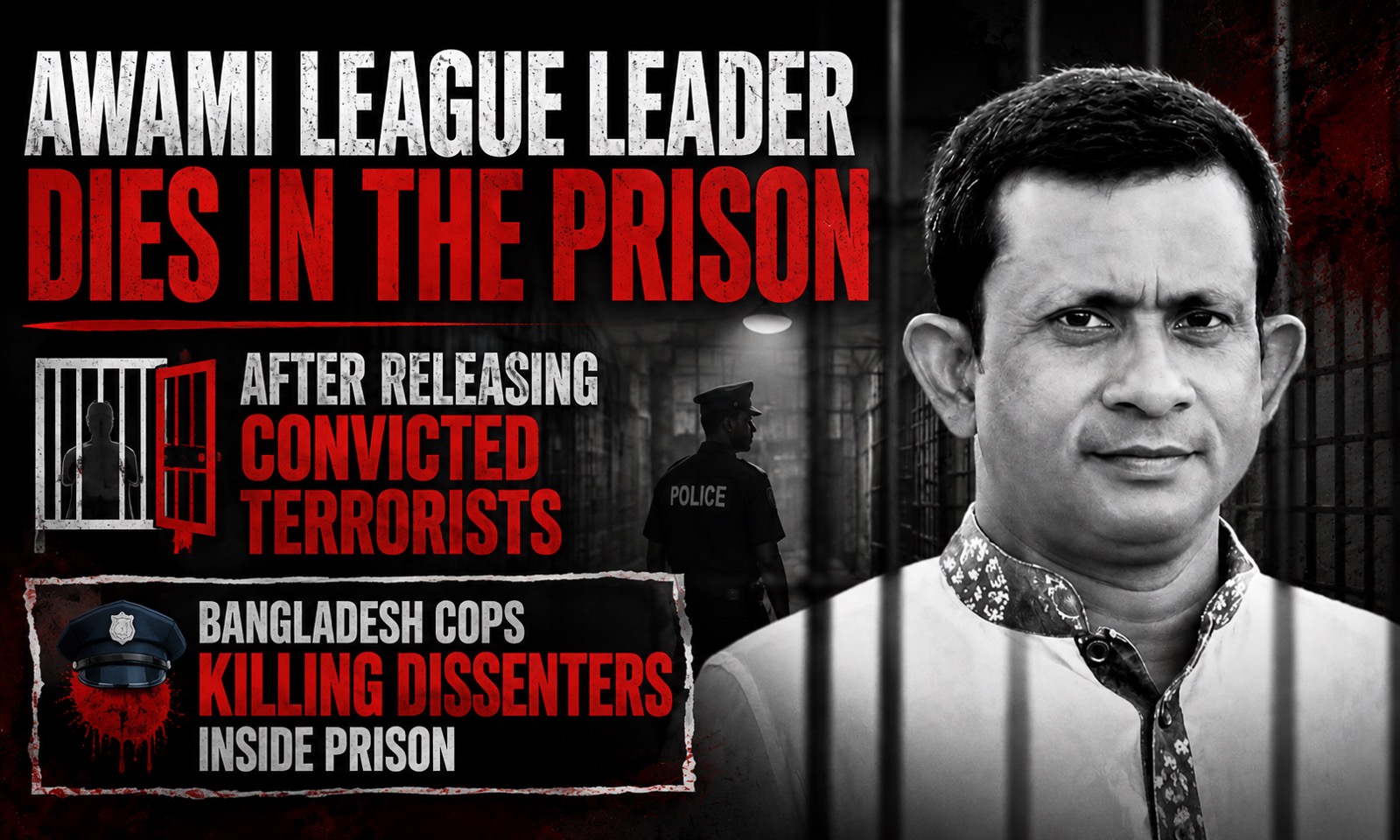
- Human Rights Watch (HRW) reported on 23 August 2026 that thousands of Awami League members and supporters have been detained, and that hundreds remain in prison without being charged with any crime. Since Prime Minister Tarique Rahman took office in February 2026, at least 10 Awami League office holders have died in prison, most of whom had not been charged.
- According to JusticeMakers Bangladesh in France (JMBF), 62 of the 84 party members who have died over the past two years died in custody. In June 2026, more than 1,000 party members were arrested in a ten-day operation.
- In cases filed in September 2024 alone, around 200,000 unnamed people were listed as accused. This month, party members continue to be arrested under the Anti-Terrorism Act in "Operation Devil Hunt" raids across several districts. Those granted bail are re-arrested at the prison gate in new cases.
(b) Violence Against Women and Children
- According to the Human Rights Support Society (HRSS), 2,404 women and girls were subjected to violence between January and September 2026. Of these, 657 were raped, including 392 children and adolescents; 130 were gang-raped; and 29 were murdered after being raped.
- In the same period, 1,810 children were subjected to violence, and 494 of them died.
- Violence against women in the first half of 2026 rose by around 56 per cent compared with the same period in 2025.
- According to the Bangladesh Mahila Parishad, 42 women and girls were murdered in October alone.
As a state party to the Convention on the Elimination of All Forms of Discrimination against Women (CEDAW) and the UN Convention on the Rights of the Child, Bangladesh has a legal duty to protect women and children. Without accountability, these commitments remain promises on paper.
(c) Violence Against Minorities
According to the Bangladesh Hindu Buddhist Christian Unity Council, 44 people were killed in 257 incidents of communal violence in the first six months of 2026. Killings rose from an average of 5.5 a month in 2025 to more than 7 a month. In Bendarchar, the home of Krishnapada Ghosh, general secretary of the local Awami League unit, was among those burned. Political and communal violence are increasingly intertwined.
(d) Repression on University Campuses
HRW reported on 3 November 2026 that at least 404 academics at 22 universities are under investigation over alleged links to the Awami League, and that hundreds of students are being expelled. Meenakshi Ganguly, HRW's deputy Asia director, said that only autocrats should fear such political debate.
(e) Persecution of Journalists
- According to HRSS, 518 journalists were attacked or harassed in the first nine months of 2026.
- Journalists Farzana Rupa and Mozammel Babu, held without charge sheets since 2024, were charged with crimes against humanity in July 2026.
- In August, new warrants were issued against three journalists, including Shyamal Dutta, over questions they asked at a press conference. The Committee to Protect Journalists (CPJ) called this "outrageous".
- In June, six journalists from the daily Agrajatra Pratidin were charged over their reporting on alleged corruption by a government minister.
- Bangladesh has fallen to 152nd place in the World Press Freedom Index of Reporters Without Borders (RSF).
The UN Framework of Analysis for Atrocity Crimes (2014) identifies several warning signs, including incitement from the highest levels, dehumanising labels and impunity for perpetrators. Several of these are visible in Bangladesh today.
8. The Garment Workers' Movement: A Legitimate Demand, Not a Conspiracy
The briefing described unrest in the garment sector as a deliberate campaign by the Awami League. We reject this claim. More than four million workers in the world's second-largest garment-exporting country have raised three demands:
- a minimum monthly wage of BDT 30,000 (currently BDT 12,500);
- an end to blacklisting;
- payment of overdue wages.
In 2023, the Awami League government formed the Minimum Wage Board in April, allowing around seven months of consultation with employers, workers and other stakeholders before the new wage was announced in November. This time, workers had long been demanding a review amid soaring inflation, yet the government did not form the Board until 1 November, after protests had already erupted. It then announced that the new wage would take effect from December, leaving barely a month for large-scale consultation and negotiation. Had the government acted in time and shown that it was serious about its commitments to workers and the international community, this situation could have been avoided.
Failing to fulfil its own commitment, the government shifted the blame onto AL-aligned RMG manufacturers. No business ever goes on to instigate such self-destruction, let alone in a labour-intensive industry.
Yet at the Minimum Wage Board meeting on 23 November, employers proposed just over BDT 14,500, less than half of what workers are asking for.
According to a JMBF report of 20 November, in 20 days of protests more than 543 workers were injured and at least 748 people were arrested, including 13 labour leaders. HRW reported violence by thugs allegedly linked to factory owners and political parties.
At least two workers have been killed:
- Toufiq Hossain, a worker at Laila Styles in Gazipur, was seriously injured on 2 November in an attack allegedly carried out by ruling party activists, and died the following day. A co-worker told HRW that Toufiq had been caught between protesting workers and men hired to suppress the protest.
- Selim, aged 23, from Kalkini in Madaripur, was attacked on 4 November in Ashulia while walking home after his factory closed for the day. A group of 10 to 12 men struck him on the head with iron rods, and he died in the intensive care unit of Dhaka Medical College Hospital on 15 November.
Police have used batons, tear gas, stun grenades, rubber bullets and water cannon against workers in several industrial areas. Around 4,000 people have been named in three cases in Gazipur, hundreds in 24 cases in Savar and Ashulia, and 1,500 unnamed people in a single case in Fatullah. Police even dispersed a funeral prayer held in Toufiq's absence. According to JMBF, 457 factories closed between August 2024 and June 2026, leaving more than 240,000 workers unemployed.
Of the 748 people arrested, 170 are Awami League members; the majority are workers and ordinary citizens. The government is arresting party members first and then presenting those arrests as "proof" of a conspiracy. This is a way of evading responsibility for the deaths of workers and the repression of their movement, and it runs contrary to the core principles of the International Labour Organization (ILO). International brands that profit from Bangladeshi garments cannot remain silent.
9. Bangladeshis Abroad and the Case Against Sheikh Hasina
We are concerned that the government has sought foreign cooperation by labelling the peaceful political activities of Bangladeshis abroad as "terrorism and money laundering." We trust that friendly states will uphold the right to asylum and the principle of non-refoulement, which prohibits returning anyone to a country where they face a risk of persecution or ill-treatment.
At the briefing, one-sided documents on the case against Sheikh Hasina were placed on the diplomats' seats. Yet leading international human rights bodies have questioned the fairness of the verdict delivered on 17 November 2025:
- Agnès Callamard, Secretary General of Amnesty International, said the trial and sentence were "neither fair nor just". Amnesty also reported that the defence was not allowed to cross-examine evidence.
- HRW noted that the trial was held in absentia and that she was not represented by counsel of her choosing.
- The UN Human Rights Office stressed that adherence to international standards is particularly vital when trials are held in absentia and result in a death sentence. It reiterated that the UN opposes the death penalty in all circumstances.
Meanwhile, the Chief Prosecutor has publicly declared that there is "no alternative" to executing Sheikh Hasina. This makes clear that what is at work is not due process but political vengeance.
10. Our Appeal
The Bangladesh Awami League calls on the diplomatic corps, the United Nations and the international community to:
(a) ensure an independent, UN-supported investigation into all acts of sabotage and violence in November 2026, the attacks on Awami League members, and deaths in custody;
(b) support an independent judicial inquiry into all violence in Gopalganj and Narail, including the events of 16 July 2025 and November 2026, so that the responsibility of all parties is assessed by the same standard;
(c) urge the withdrawal of inflammatory statements and the prosecution of those responsible for attacks;
(d) press for the lifting of the political ban, the withdrawal of mass cases, and fair trials for or the release of all political prisoners, including detained children and former members of parliament;
(e) seek justice for the killings of workers Toufiq Hossain and Selim, compensation for the injured, an end to blacklisting, and the prompt announcement of a fair minimum wage;
(f) ensure the protection of women, children and minorities, the enactment of a Minority Protection Act, and independent monitoring through the UN Special Rapporteur on violence against women and girls and the CEDAW Committee;
(g) end the punishment and expulsion of academics and students on the basis of political affiliation;
(h) secure the release of imprisoned journalists and unrestricted access for independent human rights monitors and the media;
(i) guarantee the safe return and personal security of Sheikh Hasina, former Prime Minister and President of the Bangladesh Awami League, and an independent and fair trial in line with international standards;
(j) place human rights and democratic inclusion at the centre of bilateral relations.
The Bangladesh Awami League remains committed to the spirit of the 1971 Liberation War, the Constitution and democratic values. We will continue our struggle for the rights of the people through peaceful, lawful and constitutional means.
Joy Bangla.
Joy Bangabandhu.
Bangladesh Awami League
----
Sources:
1. Human Rights Watch: pretrial detention of political opponents (23 Aug 2026); academics targeted (3 Nov 2026); garment workers' protests (5 Nov 2026); Hasina verdict and fair trial concerns (17 Nov 2025).
2. Amnesty International: Bangladesh annual report 2025; statement on the Hasina verdict (17 Nov 2025).
3. UN Special Procedures: communication to the Government of Bangladesh (29 Dec 2025).
4. UN Human Rights Office (OHCHR): statement on the Hasina verdict (17 Nov 2025).
5. UN Framework of Analysis for Atrocity Crimes (2014).
6. Committee to Protect Journalists (CPJ): statements of June and August 2026.
7. Reporters Without Borders (RSF): World Press Freedom Index 2026.
8. JusticeMakers Bangladesh in France (JMBF): garment workers' protests (20 Nov 2026); mass arrests (June 2026); deaths in custody (Nov 2026); factory closures (2024–2026).
9. Ain o Salish Kendra (ASK): Gopalganj fact-finding report (July 2025).
10. Human Rights Support Society (HRSS): reports for January–June and January–September 2026.
11. Bangladesh Mahila Parishad: monthly report, October 2026.
12. Bangladesh Hindu Buddhist Christian Unity Council: report for January–June 2026 (27 Jul 2026).
13. BBC Bangla: on-the-ground report from Bendarchar, Narail (Nov 2026).
14. Prime Minister's closing speech in Parliament (18 Nov 2026), as reported by Prothom Alo.
15. Minimum Wage Board: formation (10 Apr 2023 and 1 Nov 2026) and meeting of 23 Nov 2026, as reported by the national press and Clean Clothes Campaign.
16. National press reports on Gopalganj, Tungipara, Bendarchar, the killing of worker Selim, the Home Minister's remarks on garment manufacturers, and the Chief Prosecutor's statement (July 2025 and November 2026).
This work is copyrighted and authorized by the Bangladesh Awami League. You may download, display, print and re-produce this material in unaltered form only (retaining this notice)for your personal, non-commercial use or use within your organization.
