115
Published on November 23, 2026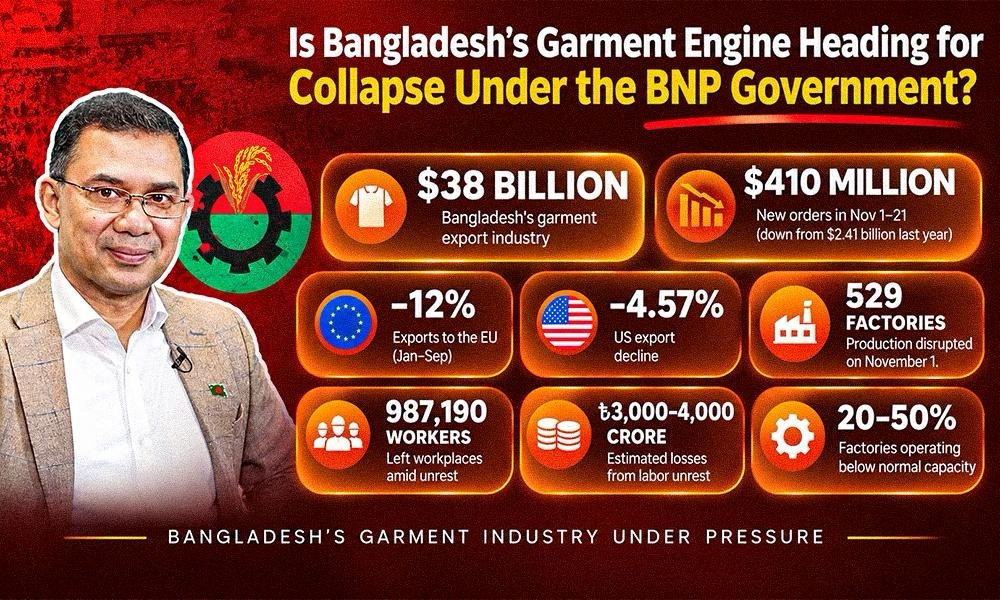
Bangladesh’s ready-made garment industry, the backbone of its export economy, is facing one of its most serious tests in decades. Factories are struggling to maintain production, international buyers are becoming increasingly cautious, and thousands of workers face growing uncertainty over their livelihoods. The crisis is unfolding simultaneously across domestic production centres and the country’s most important export markets.
The numbers are difficult to ignore.
According to figures cited by the Bangladesh Garment Manufacturers and Exporters Association (BGMEA), July exports stood at $4.73 billion, August at $4.44 billion, and September at $3.907 billion. In the first 21 days of November, new orders totaled only about $410 million, against $2.41 billion in the same period last year, a collapse of roughly $1.87 billion.
Domestic and Global Pressures Weigh on Bangladesh’s Garment Industry

Europe, still the largest market, saw shipments fall 12 percent from January to September, wiping out $1.348 billion in earnings and shrinking Bangladesh’s market share by 1.5 percentage points. The United States recorded a 4.57 percent drop and a 0.95 percent decline in average unit prices, costing another $614 million. Factories that once ran at capacity now operate 20–50 percent below normal. Small units, 1,074 of them exporting under $10 million annually, are the first to die.
Bangladesh suffers steepest export decline among EU’s major garment suppliers
For an industry responsible for approximately $38 billion in annual exports, this is not an ordinary business slowdown. It is a warning of a much deeper economic problem.
Bangladesh loses second place in garment exports to the US
|
Period / Indicator |
Export Volume |
YoY Variance / Context |
Primary Driver / Impact |
|
July Exports |
$4.730 Billion |
+6.1% baselinz |
Strong seasonal shipments post-quarter turnaround |
|
August Exports |
$4.440 Billion |
-6.1% vs July |
Initial energy supply curtailment & freight cost rise |
|
September Exports |
$3.907 Billion |
-12.0% vs July |
Onset of widespread labor unrest in Gazipur & Savar |
|
Nov 1–21 New Orders |
$410 Million |
-$1.870 Billion |
Buyer order diversion to Vietnam, India & Cambodia |
|
EU Market (Jan–Sep) |
-$1.348 Billion |
-12.0% YoY |
European retail inflation & aggressive competitor pricing |
|
US Market (Jan–Sep) |
-$614 Million |
-4.57% YoY |
Average unit prices down 0.95%; excess inventory |
Labour unrest has become one of the most immediate threats to garment production.
Since October, demonstrations over wages, factory conditions and workers' grievances have spread across Gazipur, Savar, Ashulia and Mirpur. Workers are demanding that the monthly minimum wage increase from Tk 12,500 to Tk 30,000, reflecting the growing pressure of living costs.
Factories have invoked Section 13(1) of the labour law to shut down indefinitely. BGMEA reported that production was disrupted at 529 factories on November 1, with nearly 987,190 workers leaving their workplaces. On November 18, production was reportedly disrupted at 399 factories, while 341 factories were still experiencing operational difficulties the following day.
The Bangladesh Garment Buying House Association (BGBA) has estimated losses of Tk 3,000–4,000 crore from the recent unrest.
Garment sector incurs $428m losses in 18 days amid ongoing instability
These disruptions have consequences far beyond temporary factory closures. Delayed shipments expose manufacturers to financial penalties, discounted payments, expensive air freight and cancelled orders. International buyers operate on strict seasonal schedules. They cannot indefinitely wait for a supplier whose production capacity and delivery commitments are uncertain.
This is precisely how Bangladesh risks losing business to competitors such as Vietnam, India and Cambodia.
Bangladesh's manufacturers are also fighting unreliable gas and electricity supplies, rising fuel costs and production interruptions.

Externally, the picture is no kinder.
Political instability and energy shocks in Europe have suppressed consumer demand. High inflation in the United States has left retailers with excess inventory and tight wallets. Geopolitical tensions, including conflicts that disrupted shipping and pushed up fuel prices, have raised logistics costs and made buyers cautious.
Chinese and Vietnamese competitors, facing barriers elsewhere, have flooded Europe with aggressive pricing, further eroding Bangladesh’s share. The result is a perfect storm: fewer orders, lower prices, higher costs, and vanishing margins.
If factories continue closing and international buyers relocate orders, the consequences will extend far beyond industrial zones. Unemployment will rise, household purchasing power will weaken, foreign-exchange earnings will come under pressure, and the banking sector will face additional risks from struggling manufacturers.
Bangladesh cannot afford to gamble with an industry that sustains its economic future.
The BNP government must stop treating this crisis as a collection of isolated problems. It is a national economic emergency requiring immediate action, accountability and a credible recovery strategy. If it continues to offer grand promises while factories struggle to survive, it will have to answer for the consequences.
The question is no longer simply whether Bangladesh's garment industry is declining. It is whether the government understands what the country stands to lose if it allows that decline to continue.







This work is copyrighted and authorized by the Bangladesh Awami League. You may download, display, print and re-produce this material in unaltered form only (retaining this notice)for your personal, non-commercial use or use within your organization.
