241
Published on October 21, 2026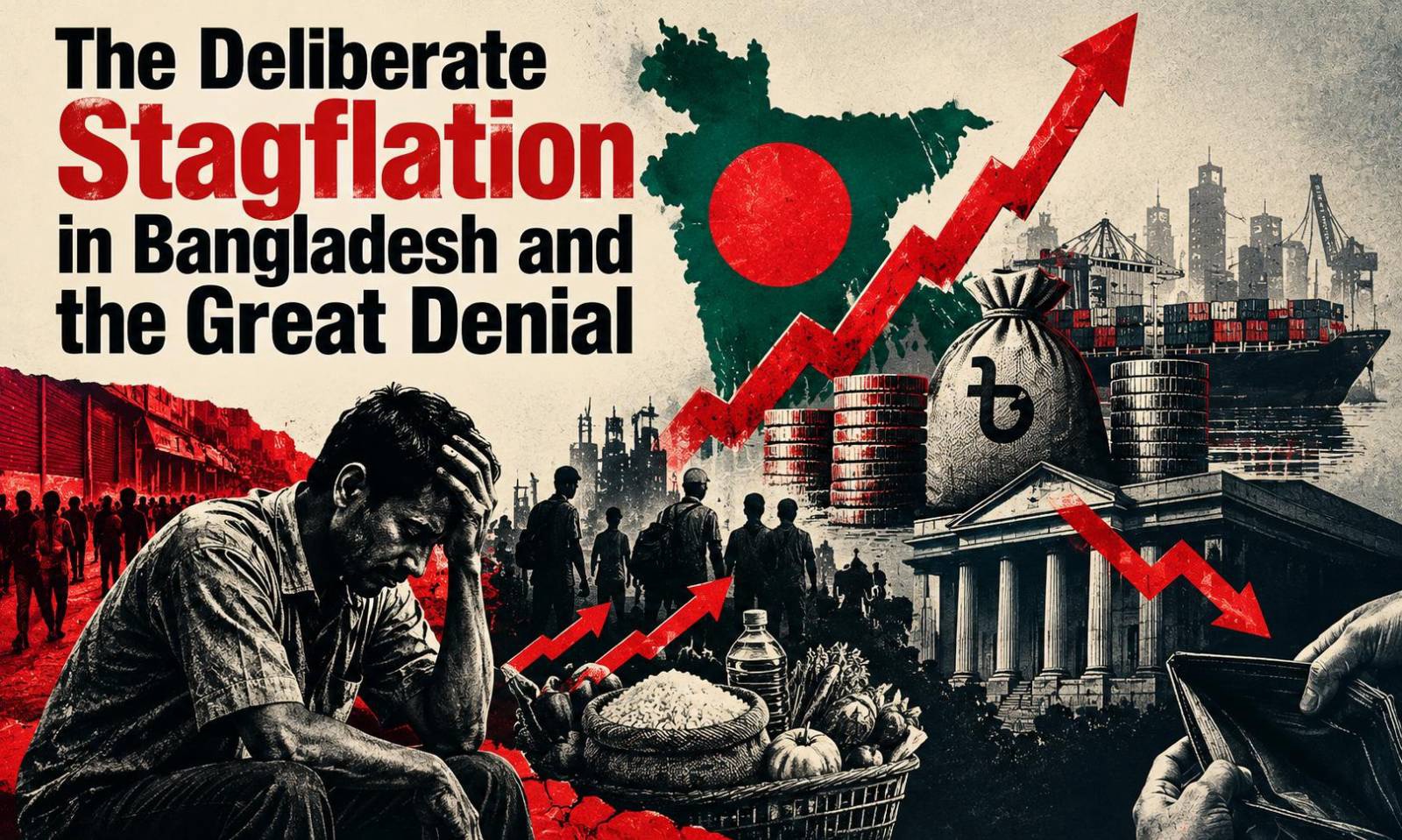
Stagflation is an economic condition characterised by the simultaneous occurrence of weaker economic growth, a relatively high inflation rate, and elevated unemployment, persisting for several years. These form a mutually reinforcing trap.
Recent years offer multiple international examples. Turkey experienced 85% inflation in late 2022. Argentina reported 200% inflation rate in 2023. Lebanon has suffered triple-digit inflation and a 98% currency collapse, and almost 40% output loss since 2019. Pakistan experienced stagflation in 2023 with 38% inflation and, like Bangladesh, its banks parked their money with the government rather than the private sector. Nigeria had an inflation rate above 30% in 2023, Egypt had 35% or more inflation in 2023-24, and Sri Lanka’s was about 70% in September 2022.
Extreme crises led to a sovereign-bank doom loop in Greece during 2010-2018, after the global financial crisis, pushing NPLs to about 45-50%. Ghana had inflation of around 54% in 2022-23, with sovereign stress feeding directly into bank balance sheets.
Asian Financial Crisis of 1997-98, Mexico’s 1994-95 crisis and Russia’s 1998 crisis were more severe, combining banking and currency problems. Oil-shock episodes in the United States and United Kingdom during 1973-97 were also flagged as stagflation, but without a linking banking-sector crisis.
Since the onset of COVID-19 and the start of the Russia-Ukraine conflict in February 2022, Bangladesh's economy has faced enormous trade and reserve pressure. Owing to higher imports during COVID-related supply restrictions, Bangladesh lost significant foreign exchange reserves to meet trade obligations.
The interim government led by Muhammad Yunus attempted major restructuring and split the NBR into two, jeopardizing internal revenue collection. This led to extensive internal bank borrowings, often at a much higher rate (10-11% of bill rates) for a prolonged period. Foreign loans followed, with higher marked-to-market rates and onerous, undisclosed covenants.
Meanwhile, uncontrolled mobs and arson attacks halted regular business activities. BNP government came to power with the first major gas shortage that closed factories, cut agricultural and industrial outputs, caused massive load-shedding, and drove up unemployment. As a by-product, the new government has overseen a threefold increase in NPLs relative to what was officially recorded when Muhammad Yunus took over.
Although the BNP government reported GDP growth estimates above 6%, it barely reached 4% in the first six months of the government. The estimates for next year, amid the energy crisis, show no positive signs. The inflation rate has consistently ranged between 8-9%.
The average rate of default rises to one-third of the outstanding loans. As a result, private sector credit growth has fallen to nearly 4-5%, while deposits are growing at around 10%. Banks are therefore discouraged from extending loans, while the direct cost of maintaining liquid funds is on the rise. As a result, banks will be forced to cut deposit interest rates.
For banks, the only financially feasible outlet in this high-liquidity, low-credit environment amid mobs and arsons is lending to the government. This has prolonged the stagnation cycle rather than alleviating it.
What are the likely outcomes? The first immediate impact is that real wages decline as price changes outpace nominal wages. Jobs will begin to disappear. In the second phase, despite desperate attempts by the central bank, rising deposits and falling private credit will lead to a credit crunch. Deposits will be discounted heavily. Artificially pushing the rates down while private credit contracts will worsen the cycle, as there is no real sector demand to drive private credit. At this juncture, lending out collateral-free credits to young entrepreneurs will only mix bad apples into an already worse credit portfolio.
In the next phase, banks will realize more losses as lower private credit and higher NPLs drive up insolvency risk. It may also trigger bank runs, as evidenced by withdrawal applications from merged Islamic banks in the last week of August.
The next most important phase, however, involves the policy dilemma. If the central bank cuts rates, inflation may erode purchasing power further and capital flight may push funds across borders in search of higher returns. If rates rise further, recession becomes imminent, and a sector-wide banking collapse deepens.
Although this dilemma is common in theory, it is very complex to manage. Weaker economies in these circumstances fall into financial depression, characterised by negative real rates, directed lending, and a sharp rise in sovereign banking sector debt.
But doing nothing can be more damaging. Some of the negative impacts are already visible in Bangladesh, particularly since the latter part of the Yunus administration. For example, state guarantees and monetisation of deficits are loading risk onto the sovereign balance sheet.
As import pressure increases, a currency depreciation pressure follows, evidenced by the sliding of the Taka from 117 to 124 per dollar in eighteen months. This pressure will be magnified if capital flows are open and savers move money abroad, until a fixed peg is introduced.
Most importantly, weaker real economic demand persists, as little has been done to boost domestic demand and production; job losses continue, inequality accelerates, poverty deepens, and human capital erodes rapidly. Interestingly, these are all documented by multiple World Bank and United Nations reports over the past two years.
Consequently, the recovery takes time, or becomes impossible, exposing masses of people to unimaginable suffering and even famine.
The best way out is a managed resolution by boosting private sector production, disciplining fiscal revenue collection, setting credit inflation targets, and recapitalizing banks to recover from the credit crisis. A late response may result in financial repression, low growth, and the emergence of so-called " zombie banks” for a very long time.
Writer: Dr Mamunur Rashid, Associate Professor in a UK university



This work is copyrighted and authorized by the Bangladesh Awami League. You may download, display, print and re-produce this material in unaltered form only (retaining this notice)for your personal, non-commercial use or use within your organization.
