9064
Published on October 3, 2026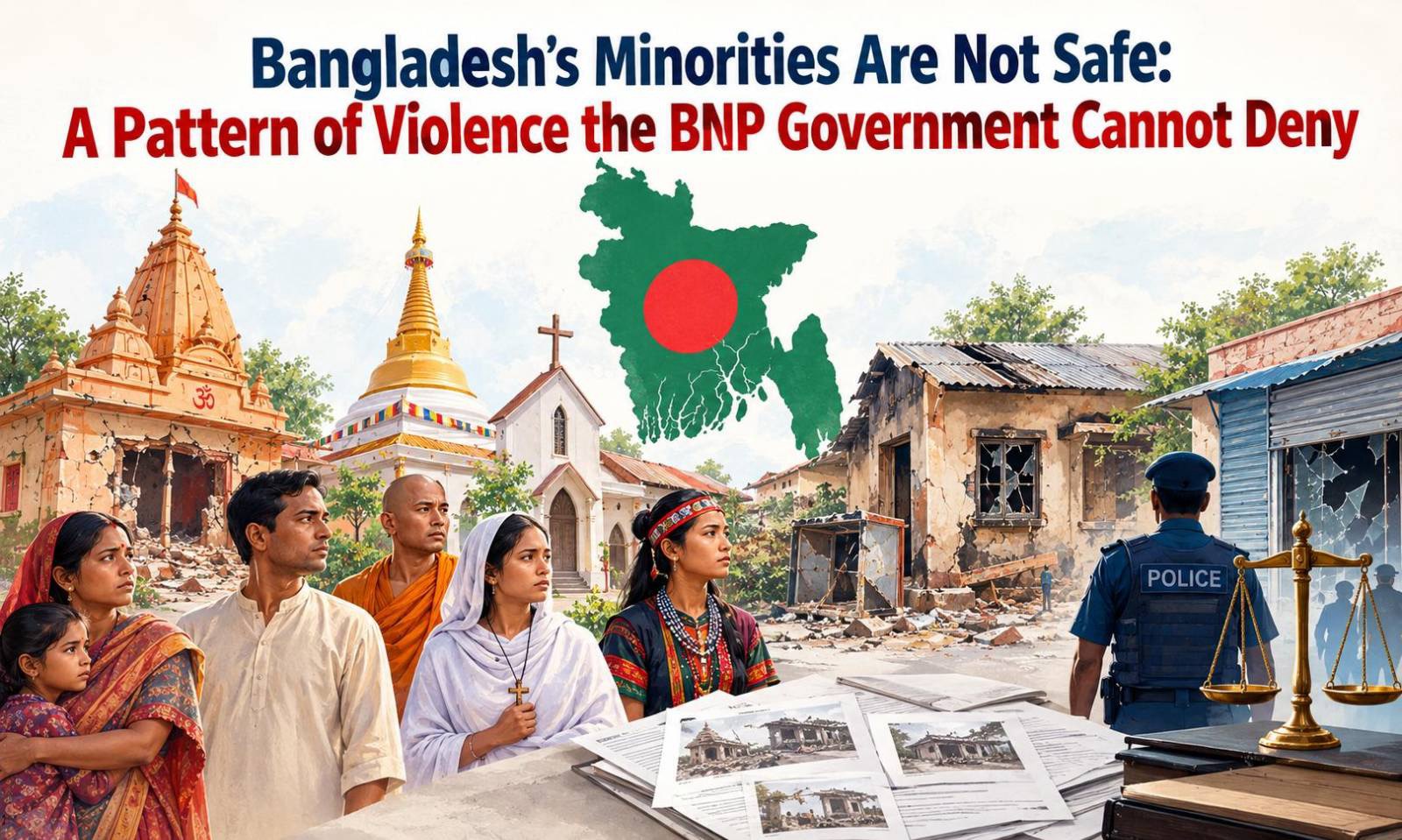
Forty-four reported deaths in six months, attacks on temples and homes, hundreds of alleged violations, and the killing of four members of a Hindu family in Rangpur have intensified fears among Bangladesh’s minorities. For Prime Minister Tarique Rahman’s new government, promises of equality must now be measured against what happens to vulnerable citizens on the ground.
Bangladesh’s religious and ethnic minorities entered 2026 with unresolved fears about their safety. The change of government has not erased them.
During the first six months of 2026, the Bangladesh Hindu Buddhist Christian Unity Council (BHBCUC) reported 257 incidents of communal violence, including 40 incidents resulting in 44 deaths. It also documented attacks on places of worship, homes and businesses, threats and attempted killings, alleged land grabbing, abductions and violence against women. The council says its figures were compiled from media reports and its own documentation and that the actual number could be higher.
Bangladesh records 257 communal violence incidents in 6 months
Another minority-rights organisation, the Human Rights Congress for Bangladesh Minorities (HRCBM), reported an even larger body of alleged violations: 824 incidents across 63 of Bangladesh’s 64 districts during January–June, including alleged land and property seizures, physical assaults, killings and mysterious deaths, attacks on religious institutions and sexual violence. These are organisational reports, not independently verified national statistics, but their scale demands serious scrutiny.
The numbers are stark:

Report on Communal Atrocities committed upon the Religious - Ethnic Minorities in Bangladesh
The warning signs continued.
According to figures presented by the BHBCUC in August, at least 41 incidents of partial communal violence were reported across Bangladesh in July, based on incidents appearing in newspapers. The organisation listed six killings, two rape cases, 10 incidents involving vandalism or looting at temples and idols, five attacks on Indigenous people, 10 attacks or cases of vandalism and looting targeting homes and businesses, and two cases of forcible land grabbing. The council described the July figure as partial.
This matters because minority security cannot be measured only by the number of cases that authorities officially classify as “communal.” A Hindu family whose home is attacked, an Indigenous community whose land is seized, or a temple that is vandalised still needs protection and justice regardless of which administrative category a police report eventually assigns to the incident.
That classification dispute has already shaped Bangladesh’s response.
The current crisis did not begin with the BNP government.
In January, the former interim government cited Police Headquarters data showing 645 incidents involving minority-community members in 2025. Police classified only 71 as having a communal element, while 574 were attributed to general criminal activity, including theft, land disputes, neighbourly disputes, rape, unnatural deaths and other offences. The government said the review was based on FIRs, general diaries, charge sheets and investigation updates.
Bangladesh Records 645 Minority Incidents in 2025

That distinction cannot simply be ignored. A crime against a minority citizen is not automatically a communal crime because of the victim’s identity. But the opposite is also true: describing an incident as criminal does not by itself answer whether prejudice, intimidation, land grabbing, religious hostility or institutional failure played a role.
The disagreement between official classifications and minority organisations therefore deserves independent examination rather than political dismissal.
And it is precisely here that the new government inherits a difficult test: will it investigate these claims transparently, or will it repeat the cycle of competing statistics and competing narratives?
The killing of four members of a Hindu family in Rangpur has become the most disturbing test of that question.
On August 22, the bodies of retired Rangpur Zilla School teacher Ganapati Chakraborty, 65; his wife Pritilata Chakraborty, 50; their daughter Agami Chakraborty; and their son Ayush were recovered from their home in Machuapara. Police said all four had been strangled.
Two young men from the neighbourhood, Siddhartha Das and Mugdha Das, were subsequently detained and arrested in connection with the killings. Police alleged that the men had been using yaba on the rooftop, were confronted by Ganapati, and subsequently killed the family. Police later cited a possible land dispute as another element of the investigation.
Rangpur four murders: Siddhartha, Mugdha test negative for drugs
But the case quickly became controversial.
The investigation was transferred to the Detective Branch. Police ordered DNA and drug tests as part of the investigation. The post-mortem examination confirmed strangulation and found no chemical-burning marks. Investigators also said there was no forensic evidence of rape.
Then came a development that raised further questions about the initial narrative: reports said the two suspects' drug tests were negative, meaning no evidence of drug use was detected in their bodies.

By September 29, more than a month after the killings, the case remained unresolved. Police were still examining the suspects’ statements and forensic evidence, while the precise motive remained unclear.
That does not prove the killings were communal. No responsible investigation should make that claim before the evidence establishes it.
But it does establish something else: the original explanation has not put the questions to rest.
Four Killed in Rangpur; Police Trying to Conceal the Truth, Says Oikya Parishad
The BHBCUC has demanded a judicial inquiry, arguing that the police account is not credible and that the killings have created fear among minorities nationwide. At a Dhaka protest, minority leaders called for a parliamentary statement and an independent investigation.
For the government, the answer should be straightforward: establish the facts, publish the forensic findings, explain the evidentiary basis of the police theory, and prosecute whoever is responsible.
Anything less will deepen suspicion.
Prime Minister Tarique Rahman has publicly set a high standard for his government.
On July 16, meeting representatives of ethnic minority communities, he said:
“My government and I are working to build a discrimination-free Bangladesh.”
He also described ethnic minorities as an inseparable part of the country and said his government wanted equal rights and opportunities for all communities.
Days earlier, Tarique said his BNP-led government would not tolerate extremism or militancy and spoke of a Bangladesh based on justice and fairness where no one would face discrimination.
Those statements should not be treated as mere political rhetoric. They provide a clear standard against which the government's conduct can be measured.
If Bangladesh is to be a “discrimination-free” country, minorities must be able to expect more than assurances. They must be able to expect protection when their homes are attacked, their places of worship are vandalised, their property is threatened or their families are murdered.
The issue is larger than any single murder.
A country seeking international investment, trade, diplomatic credibility and a stronger democratic identity cannot afford a widening gap between its promises on minority rights and the experiences reported by minority communities.
The international community should therefore ask Bangladesh's government specific questions—not make assumptions.
How many attacks against minorities have been reported in 2026? How many have been investigated? How many suspects have been charged? How many cases have reached trial? How many perpetrators have been convicted? How many disputed land seizures have been reversed? How many attacks on religious institutions have resulted in convictions?





This work is copyrighted and authorized by the Bangladesh Awami League. You may download, display, print and re-produce this material in unaltered form only (retaining this notice)for your personal, non-commercial use or use within your organization.
