975
Published on September 30, 2026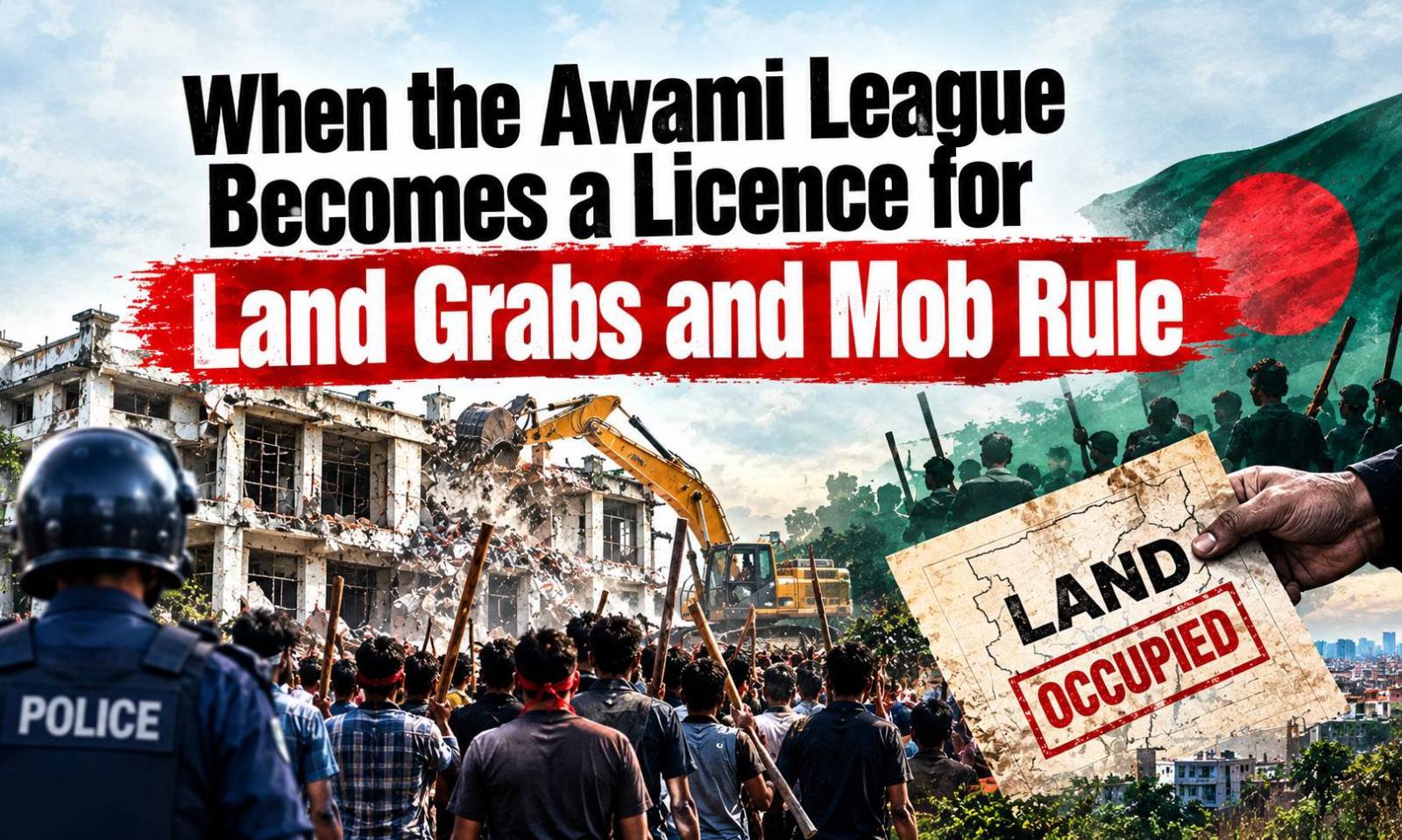
Bangladesh’s recent wave of alleged land grabs, political intimidation, and police inaction raises a question the BNP government cannot evade: who protects citizens when political connections appear to matter more than the law?
A chillingly predictable playbook has taken hold across Bangladesh: brand any target an "Awami League operative," deploy an aggressive political mob, ensure security forces remain silent spectators, and seize the physical assets. What was initially sold to the international community as transitional accountability has rapidly devolved into a systematic, regime-sanctioned campaign of land grabbing and asset expropriation.
Extortion, land grabs take a new turn in Dhaka with little police intervention
Under the newly established Bangladesh Nationalist Party (BNP) governance, steered by party chief Tarique Rahman, the nation is witnessing a coordinated wave of extrajudicial occupations. Far from establishing democratic stability or restoring the rule of law, Rahman's infamous declaration, "I have a plan", is revealing its true, sinister architecture: an infrastructure designed to enforce territorial control, crush civic independence, and redistribute private capital through state-backed mob violence.
Between 24 and 26 September 2026, Dhaka witnessed a coordinated surge of violence that followed a grimly familiar script.
Will this vandalism and land grabbing become the 'new normal in Bangladesh'?

Radda MCH-FP Centre, Mirpur-1: Around midnight on 24–25 September, 200–250 masked men armed with sticks, hammers, and local weapons overran a five-decade-old maternal and child health clinic that had served the poor free of charge in partnership with the government. Security guards were beaten and tied up. Medicines, government EPI vaccines, ultrasound machines, generators, cash, and records were looted. Heavy machinery then demolished one permanent and three semi-permanent buildings. A signboard of “Somomona Dokandar Samabay Samiti Ltd” was erected. Police were present; CCTV showed officers standing by as goods were loaded onto pickups. Estimated damage: over Tk 1.5 crore. A case named local BNP figure Hanif Mia and 200–250 others. Arrests followed; the Shah Ali OC was withdrawn, yet key accused remain free.
Radda clinic demolition: Names of BNP, Jubo Dal, Chhatra Dal emerge among those involved
Brownfish Studio, ECB Chattar: On the night of 26 September, two truckloads of attackers stormed content creator Salman Muqtadir’s studio inside the New Gini Properties complex. Equipment worth nearly Tk 1 crore was vandalised and looted amid gunfire. The pretext was a land dispute; the method was pure mob force. Police later arrested a handful, including a purported planner.
Attack on Salman Muqtadir's studio
JASAD Central Office, Gulistan: During a scheduled central representatives’ meeting on 26 September, Jubo Dal activists allegedly created a mob, assaulted participants and trapped hundreds inside. Police then raided the premises, detaining nearly 300 people on suspicion of being banned Awami League activists. Most were later released; 27 were sent to jail for chanting slogans. JASAD had informed police in advance. The Home Minister later justified the raid as action against an “Awami League plot.”
ASK condemns attack on Jasad office, detention of 289
These cases are not identical. But each raises the same fundamental question: are state institutions protecting citizens’ rights, or allowing political power to determine whose rights count?

These incidents are merely the visible tip of an iceberg. Across the country, including urban centers and rural sub-districts in Chittagong, Khulna, and Rajshahi, a broader campaign of intimidation is unfolding outside the media spotlight:
Commercial Extortion & Business Seizures: Small and medium business owners who refuse to pay extortion fees to local party bosses are immediately slapped with the "Awami" label. Within days, vigilante groups force business closures or install regime loyalists as "managing partners."
Residential Evictions & Land Grabbing: Private landholders and residential homeowners face illegal eviction notices issued by informal party tribunals. Refusal to comply results in midnight property attacks, utility disconnections, and physical threats.
Institutional Takeovers: Educational institutes, charitable trusts, and community centers have seen their governing boards ousted by mob force. Qualified administrators are replaced by politically connected operatives seeking access to institutional funds.
Transparency International Bangladesh has documented a nationwide pattern of land grabbing and extortion by sections of BNP leaders and activists since August 2024 that has only intensified under the new government. Control of major bus terminals (Sayedabad, Mohakhali, Gabtoli), footpaths, markets, water bodies (jalmahals), sand quarries, cable networks and waste-collection rackets has changed hands. In Kishoreganj, rival BNP factions clashed over a water body, injuring more than 50. In Mohammadpur and Adabor, offices and homes were attacked within the same 72-hour window as the three signature cases.
Failure to curb land grabbing, extortion an 'ominous sign' for ruling party: TIB
TIB Executive Director Iftekharuzzaman called the failure to curb these activities an “ominous sign” for the ruling party and demanded a party-wide purification drive. The message from the streets is clearer: the Awami League tag has become a blank cheque for forcible seizure.
When Tarique Rahman returned from exile in December 2025 and stood before a massive crowd in Purbachal, he borrowed Martin Luther King’s cadence but delivered a different line: “I have a plan.” He framed it as a roadmap for development, safety, and changing the fortunes of ordinary citizens.
Today, the reality of that plan is starkly visible on the streets of Dhaka.
Rahman’s "plan" is nothing short of a state-sanctioned infrastructure for wealth redistribution and territorial capture. By subverting state apparatuses, turning cabinet ministers into subservient caretakers and transforming police into enforcement arms for local mobs, the regime is replacing constitutional governance with party feudalism.

The international community, particularly Western trade partners, international financial institutions, and human rights bodies, can no longer treat these illegal occupations as routine political friction following a power shift. To prevent Bangladesh from sliding into complete lawlessness, international stakeholders must immediately enact strict measures:
If the global community permits Tarique Rahman's regime to continue normalizing state-backed mob rule, Bangladesh’s fragile democratic framework will be permanently destroyed. The world must act now before lawless confiscation becomes the permanent law of the land.





This work is copyrighted and authorized by the Bangladesh Awami League. You may download, display, print and re-produce this material in unaltered form only (retaining this notice)for your personal, non-commercial use or use within your organization.
