7652
Published on September 22, 2026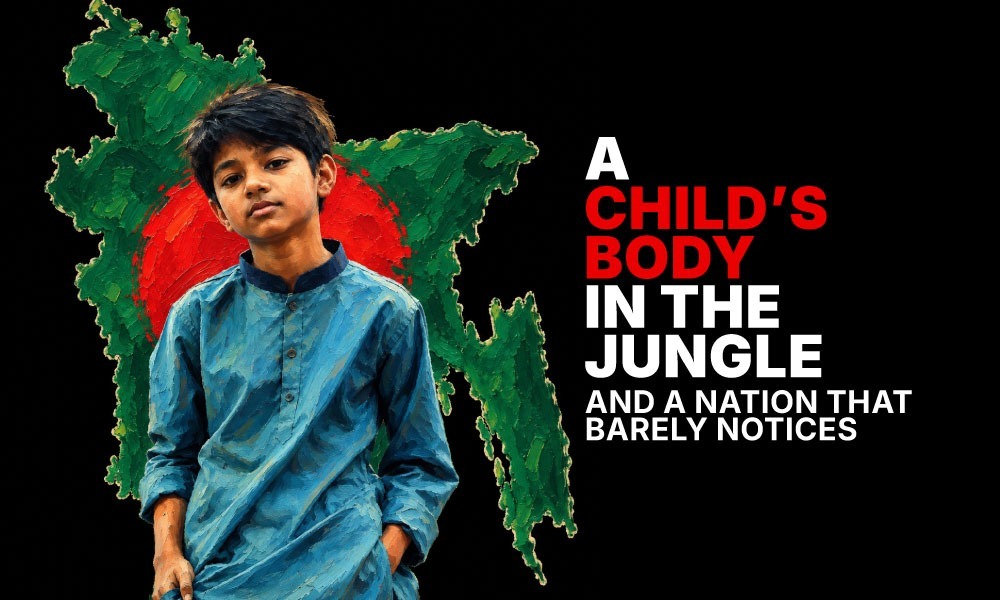
The gruesome murder of 13-year-old Ishiat Shahriar Oprotimo exposes an unprecedented breakdown of security, where no child, citizen, or household is safe.
Thirteen-year-old Ishiat Shahriar Oprotimo left home on a Friday afternoon in Cumilla with his mother’s iPhone, saying he wanted to take photographs with friends. Roughly twenty-four hours later, his body was found in a wooded patch of Lalmai Hill. He had been beaten to death. Police say the motive was the phone. Four young men, some of them acquaintances, have been arrested and three have confessed.
Police say 13-year-old Oprotim was killed over his iPhone
That is the official story. It is tidy, rapid, and already being held up as evidence of police efficiency. It is also a symptom of something far more rotten.
Oprotimo’s death is not an aberration. It is one more entry in a ledger that should shame any government claiming to protect its citizens. Between January and July this year, police recorded 15,717 general diaries for missing children, an average of roughly seventy-five children vanishing every single day. Nearly 13 percent of them remain unaccounted for. Many of those who reappear do so as corpses.
15,717 children reported missing in Bangladesh in Jan-July 2026, 2,038 untraced: Police

254 children killed in eight months
Independent tallies of child murders paint an equally grim picture. Rights groups have documented more than 150 children killed in the first eight months of 2026 through murder, rape followed by killing, family violence, and abuse. The real number is almost certainly higher. Most cases never make the front page. A ten-year-old’s body in Pabna, a girl named Fahima in Sylhet, Ramisa in Pallabi, a schoolgirl in Panchagarh, each one reduced to a brief report and then forgotten. Evidence of sexual assault appears with sickening regularity.

This is not random misfortune. It is the predictable result of a society in which the weak have no reliable shield. Children are abducted for ransom, raped, and discarded. Families poison their own. Mob justice fills the vacuum left by courts that move too slowly or not at all. The recovery of three bodies from one family in Manikganj, a housewife murdered in Gazipur, a father who tried to kill his children and himself in Sunamganj- these are not isolated tragedies. They are the texture of daily life in large parts of the country.
'You lost your child, what can I do?': Missing child's parent alleges police apathy
The authorities respond to high-profile cases with statements of resolve and promises of speedy trials. In Oprotimo’s case, they moved fast. That speed only underscores the selective nature of the response. Most missing children never receive the same urgency. Most murdered children never become national news. The machinery of the state works when the cameras are watching, and the victim has a middle-class parent who can make noise. For everyone else, the system is indifferent.
Rule of law is not a slogan. It is the assurance that a child can walk out of a residential area in the afternoon and return alive. That assurance no longer exists for tens of thousands of Bangladeshi families. When seventy-five children are reported missing every day and a significant share never come home, the problem is no longer one of individual criminals. It is systemic collapse, of policing, of social protection, of the basic expectation that the state will keep the vulnerable from being preyed upon.
The murder of Oprotimo should have been a national emergency. Instead, it risks becoming another data point, another brief media cycle, another set of arrests that will fade once the confessions are recorded. The parents of every missing or murdered child deserve more than that. The country itself deserves more than that.
There is no consolation in statistics. There is only the hard fact that Bangladesh is failing its children at an industrial scale. Until that failure is treated as the crisis it is, until investigations are thorough, prosecutions relentless, and prevention real, the jungle will keep receiving more bodies, and the headlines will keep moving on.




This work is copyrighted and authorized by the Bangladesh Awami League. You may download, display, print and re-produce this material in unaltered form only (retaining this notice)for your personal, non-commercial use or use within your organization.
