1359
Published on September 4, 2026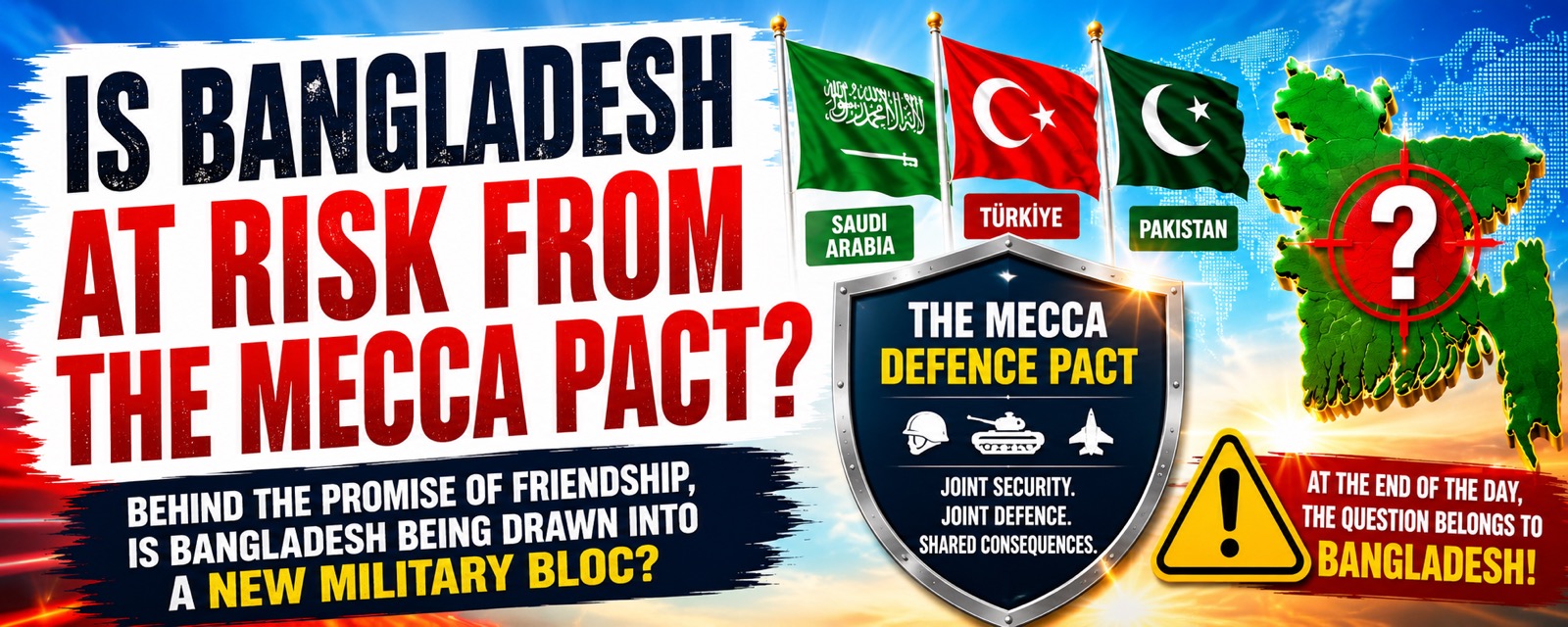
Bangladesh has spent decades trying to do something that is increasingly difficult in a divided world: maintain good relations with everyone without becoming strategically dependent on anyone.
Its relationships with India and China are central to its security and economy. The United States and Europe are indispensable to its trade. Saudi Arabia and other Gulf countries provide employment for millions of Bangladeshis and are important sources of remittances. Türkiye has emerged as an increasingly significant partner, while Bangladesh has sought to maintain normal relations with Pakistan.
That balancing act has not always been easy. But it has given Bangladesh something valuable: room to maneuver. The proposed Mecca Defence Pact between Saudi Arabia, Türkiye and Pakistan raises a question that goes well beyond whether Bangladesh should deepen its relations with three friendly countries.
The question is whether joining a formal security and defence framework could eventually constrain the very strategic independence that Bangladesh has spent decades protecting.
A defence arrangement is different from a diplomatic friendship. It creates expectations, establishes strategic relationships and, depending on its terms, can create obligations when one member faces a crisis.
That distinction deserves far more scrutiny than it has received.
Bangladesh's government has spoken positively about the pact and indicated that it would look favorably on joining if an invitation were extended. Officials have also suggested that membership would pose no significant risk to Bangladesh.
That assertion, however, raises a more important question: On what assessment is it based?
A decision involving national security cannot rest simply on assurances that there is little to worry about. It requires a careful examination of possible scenarios, including those that may be politically uncomfortable.
Has the government assessed how India might respond?
Has it examined the strategic implications of entering a defence framework alongside Pakistan?
Has it considered whether membership could create expectations for Bangladesh if one of the other members became involved in a military confrontation?
And has it assessed how such an arrangement would affect Bangladesh's ability to maintain neutrality in conflicts that do not directly concern it?
If those assessments have been conducted, the public deserves to know at least their broad conclusions. The issue is not whether Bangladesh should cooperate with Saudi Arabia, Türkiye or Pakistan. It should. The issue is whether cooperation should take the form of a military commitment.
The most consequential question may be the simplest: What happens when a member of the pact goes to war?
At present, the discussion can easily be framed around friendship and strategic opportunity. But alliances and defence arrangements are tested not when relations are calm, but when the countries involved face crises.
Suppose a member of the pact becomes embroiled in a major conflict. Would Bangladesh be expected to offer political support? Intelligence cooperation? Logistical assistance? Military cooperation?
Perhaps the answer would be no.
But that answer needs to be established before Bangladesh joins, not negotiated in the middle of a crisis. Wars do not provide governments with the luxury of discovering the meaning of their commitments after hostilities have begun.
That is why the precise obligations of any defence arrangement matter so much.
Bangladesh has traditionally benefited from maintaining a degree of strategic flexibility. It has participated in international security efforts, including United Nations peacekeeping, while generally avoiding formal alignment with competing military blocs.
A new defence commitment could complicate that posture.
No discussion of Bangladesh joining a defence structure that includes Pakistan can avoid India.
Bangladesh and India share a border, rivers, trade routes, energy connections and a long list of security interests. Cooperation between the two countries affects everything from border management and water-sharing to regional connectivity and economic integration.
Pakistan is a very different strategic proposition.
Relations between Dhaka and Islamabad have improved in some areas in recent years, and there is nothing inherently problematic about Bangladesh maintaining normal and constructive relations with Pakistan.
But normal relations are not the same as sharing a security architecture. If Bangladesh were to enter a defence framework with Pakistan, New Delhi would inevitably have to consider what that meant for its own security environment.
That does not necessarily mean India would respond negatively. Nor does it mean Bangladesh should allow India's preferences to dictate its foreign policy.
It does mean that the potential consequences should be assessed realistically. The question Bangladesh should ask is not simply what it might gain by joining the pact. It should also ask what existing strategic relationships could become more difficult as a result.
This is not an abstract concern. A future confrontation between India and Pakistan, whether limited or prolonged, would immediately place Bangladesh in a difficult position.
Would Bangladesh remain neutral?
Could it do so while being part of the same defence framework as Pakistan?
Would the other members of the pact accept that neutrality?
Would India regard Bangladesh's membership as evidence of strategic alignment with Pakistan, regardless of what Dhaka said publicly?
There may be perfectly reasonable answers to each of these questions. But they need to be answered before membership, rather than after a crisis has begun. Foreign policy is not only about today's relationships. It is about preserving options for tomorrow.
The Middle East is of enormous importance to Bangladesh, but largely for reasons that argue for stability rather than military alignment.
Millions of Bangladeshis live and work across the Gulf. Their remittances support families and contribute significantly to the country's economy. Instability in the region can affect energy prices, employment, migration and Bangladesh's broader economic security.
That makes peace in the Middle East a Bangladeshi interest.
It does not make every conflict in the Middle East a Bangladeshi conflict.
Saudi Arabia, Türkiye and other regional powers have their own strategic interests, rivalries and security calculations. Those interests do not necessarily coincide with Bangladesh's.
A defence pact could blur that distinction.
If one member faces a security crisis, what would Bangladesh be expected to do? Would diplomatic solidarity be enough? Would intelligence cooperation be expected? Could logistical or military assistance eventually become part of the conversation?
These are not reasons to reject cooperation.
They are reasons to define the cooperation carefully.
Bangladesh occupies an unusual position in the emerging geopolitical competition in Asia.
It has important economic and strategic relationships with China. It has an unavoidable security relationship with India. Its exports depend heavily on markets in the United States and Europe. Its labor force and remittance economy are deeply connected to the Gulf. It has expanding ties with Türkiye and has sought to maintain relations with Pakistan.
The country's strength, in many ways, lies in not having to choose one relationship at the expense of all others.
That flexibility is increasingly valuable as competition among major powers intensifies.
Joining a specific military framework could narrow it.
A defence pact does more than facilitate military cooperation. It can influence perceptions of alignment. It can shape the expectations of partners. And it can reduce a government's freedom to respond independently when a crisis arrives.
For a country such as Bangladesh, which must simultaneously manage relations with several competing power centers, that loss of flexibility could carry a significant strategic cost.
There is no contradiction in Bangladesh being close to Saudi Arabia.
There is no contradiction in expanding defence and economic cooperation with Türkiye.
There is no reason Bangladesh should not maintain constructive relations with Pakistan.
But none of those relationships necessarily requires Bangladesh to join a common military framework.
Bangladesh can have friends without inheriting their enemies.
That distinction should remain at the center of the debate.
Foreign policy can be built on goodwill and friendship. National-security policy must be built on calculations of risk, capability and national interest.
If the government believes that the Mecca Pact carries little or no risk for Bangladesh, it should explain why.
What happens if India objects?
What happens if India and Pakistan enter another conflict?
What obligations would Bangladesh have if a member of the pact came under attack?
Could Bangladesh decline military assistance?
Would it be free to remain neutral?
Would intelligence-sharing or logistical support be expected?
And, ultimately, would Bangladesh retain complete freedom to determine its own foreign and security policy after joining?
These are not hostile questions. They are basic questions that any government should expect when considering a defence commitment.
International agreements can be signed in a day.
Their consequences can last for decades.
The government that makes a commitment today may not be the government called upon to defend or reinterpret it years later. The leaders who negotiate an agreement may leave office long before its strategic consequences become apparent.
That is why national security requires a longer view than ordinary diplomacy.
Bangladesh should conduct a comprehensive security assessment before taking any step toward membership. It should examine the military, diplomatic and economic implications, consider possible reactions from India and other major partners, and clearly establish what obligations membership would create.
The public should also be given a meaningful explanation of those findings.
The central issue is not whether Bangladesh should cooperate with Saudi Arabia, Türkiye or Pakistan.
It should.
The issue is whether Bangladesh should place that cooperation inside a defence framework that could one day limit its freedom to act independently.
Bangladesh needs relationships with all of these countries. It needs trade, investment, employment opportunities, security cooperation and diplomatic goodwill.
But it also needs something that may be harder to recover once surrendered: strategic autonomy.
Before joining the Mecca Defence Pact, therefore, the government should answer a straightforward question.
What does Bangladesh gain by joining—and what, precisely, is it prepared to risk in return?
That is not a question of being for or against Saudi Arabia, Türkiye or Pakistan.
It is a question of whether Bangladesh intends to choose its own side when the next crisis comes.






This work is copyrighted and authorized by the Bangladesh Awami League. You may download, display, print and re-produce this material in unaltered form only (retaining this notice)for your personal, non-commercial use or use within your organization.
