1551
Published on August 31, 2026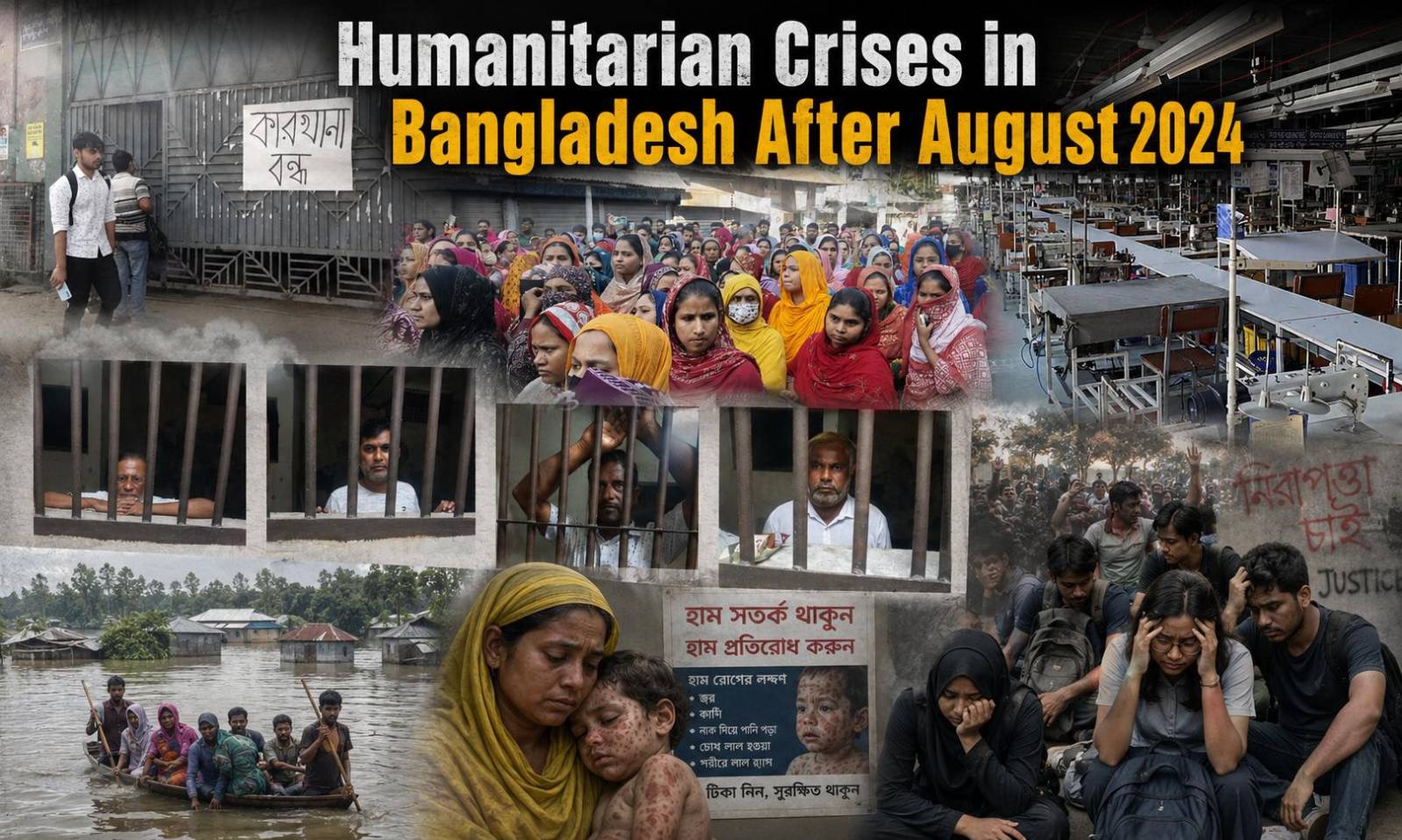
Since August 2024, political instability, economic pressures, declining employment in the industrial sector, public health risks, rising poverty and climate-related disasters have compounded one another in Bangladesh.
According to information from various sources, the humanitarian impact during this period has reached significant levels across multiple sectors, with children, women, workers and low-income communities particularly affected.
Education and Political Detention
In the education sector, approximately 33 million children have experienced disruptions to their education due to political instability and climate-related events.
At the same time, political arrests and detentions have remained a serious concern. In Dhaka, more than 5,079 people were reportedly arrested in connection with 707 cases. At the national level, opposition political groups have claimed that more than 400,000 people have been arrested, while approximately 30,000 people were reportedly in custody as of November 2025.
Industrial and Employment Crisis
The impact on industry has been even broader. More than 500 large export-oriented factories, including garment factories, have reportedly closed. More than 300 of these closures were reported by October 2024.
Garment export earnings reportedly fell by around 12 percent, from approximately $42 billion to $37 billion.
Overall, an estimated 1.5 million workers have lost their jobs. Among individual companies, the reported lay-offs of approximately 40,000 workers at the Beximco Group, along with the closure of 80 factories in the leather sector, are particularly significant.
In Dhaka's ceramics industry, more than 100 factories or production units have reportedly either closed or become inactive.
Disproportionate Impact on Women
The industrial crisis has had a disproportionate impact on women. Women account for approximately 80 percent of the workforce in the garment sector, yet the available information indicates that women may account for around 90 percent of total job losses. As a result, the industrial downturn has placed additional pressure on both women's employment and the economic security of households.
Public Health Crisis
The outbreak of measles has emerged as a particularly serious public health concern. As of 24 August 2026, the figures provided indicate more than 915 suspected or confirmed child deaths, alongside 131,946 suspected cases and 16,531 confirmed cases. The disease has reportedly spread across all 64 districts of Bangladesh, while routine immunisation coverage has declined by approximately 4–5 percentage points annually.
Child Safety and Mental Health
The situation surrounding child safety is also concerning. During the seven months following the political transition, approximately 15,000 general diaries (GDs) related to child abduction were reportedly filed. At the same time, the mental health crisis among university students has intensified. According to the figures provided, 86.3 percent of students reported serious anxiety or depression-related mental health problems. In addition, 38.05 percent of students said they had occasionally participated in some form of protest, while 29.56 percent reported participating regularly.
Rising Poverty
Poverty has also increased. According to the latest United Nations report cited in the information provided, more than 60 million people are living within a vulnerable poverty threshold.
Climate and Disaster-Related Humanitarian Impact
Climate-related disasters have further deepened these crises. The weakening of local government structures has reportedly undermined basic disaster-prevention and preparedness mechanisms. In 2024, four major climate-related disasters affected approximately 18.4 million people. Cyclone-related impacts alone affected around 4.6 million people and displaced approximately 800,000. Flooding affected millions of people, including approximately 7 million children. The number of people internally displaced by disasters is estimated at around 2.4 million. Over the past three decades, climate change has caused average annual economic losses of approximately $3 billion. Flash floods have also been linked to at least 71 recorded deaths.
A Multidimensional Humanitarian Crisis
Taken together, these figures suggest that the crisis following September 2024 is not confined to any single sector. Political instability, declining employment, poverty, public health risks, child safety concerns, deteriorating mental health and climate-related disasters are interconnected/.
Together, they are placing multidimensional pressure on Bangladesh's social and economic stability, with the effects falling particularly heavily on vulnerable groups, including children, women, workers and low-income households.
Writer: Dr Mamunur Rashid





This work is copyrighted and authorized by the Bangladesh Awami League. You may download, display, print and re-produce this material in unaltered form only (retaining this notice)for your personal, non-commercial use or use within your organization.
