28767
Published on July 29, 2026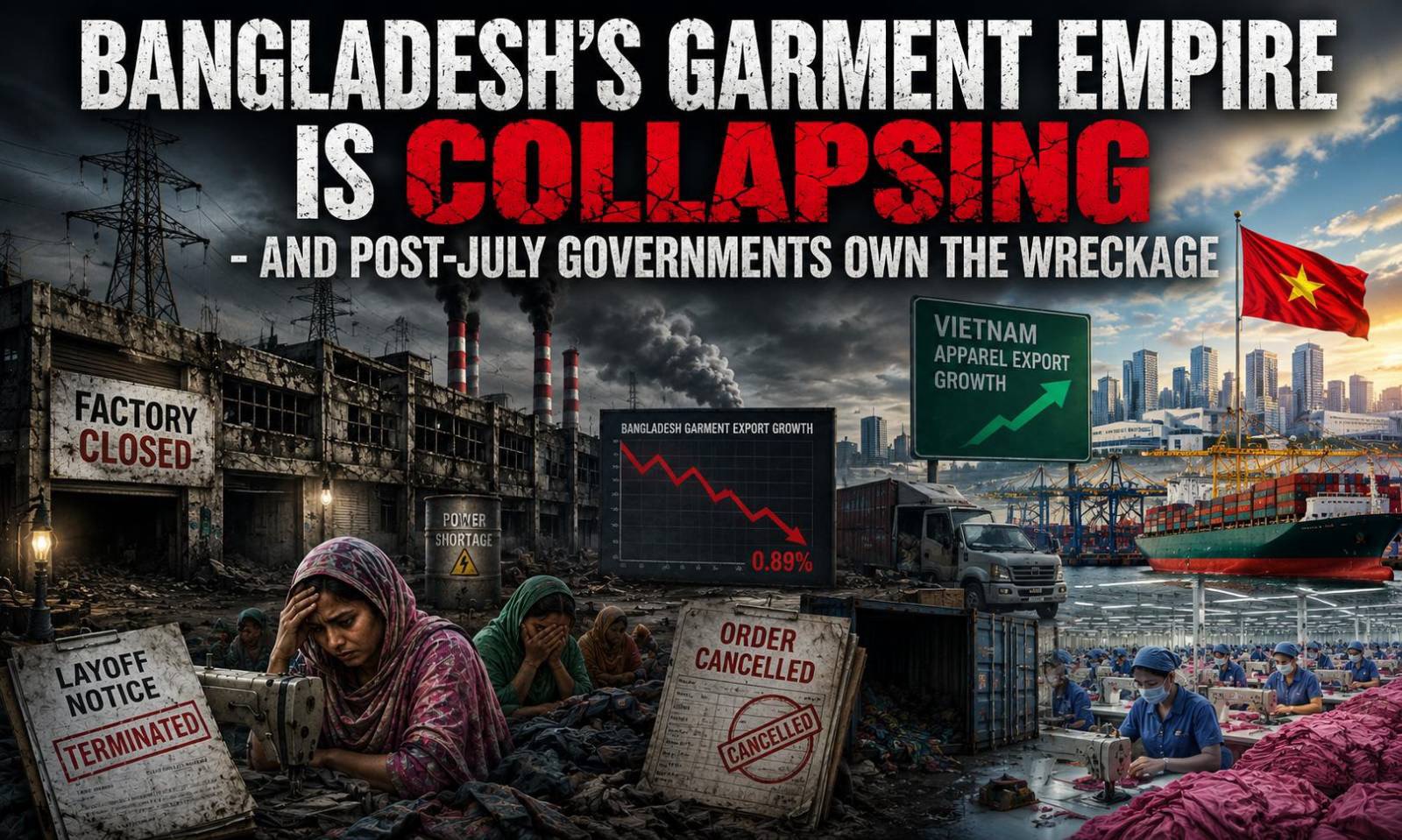
For over four decades, Bangladesh’s Ready-Made Garment (RMG) sector stood as an unassailable miracle of modern industrial growth. Commanding over 80% of the nation's export revenues, the $40 billion industry transformed the country into the world’s second-largest apparel exporter, providing direct employment to over four million workers, primarily women.
But today, that status is gone.
Following the political upheavals of the July 2024 movement, Bangladesh’s flagship export industry has suffered catastrophic market erosion. According to World Trade Organization (WTO) data, Bangladesh has officially lost its long-held second-place global position to Vietnam, recording a paltry 0.89% apparel export growth, the lowest among major Asian competitors, while the broader global apparel market expanded by 4.46%.
Bangladesh loses second spot to Vietnam in global garment exports
Is Bangladesh's $23b textile sector edging towards collapse?
This industrial dismantling is not a force of nature or a mere casualty of global inflation. It is the direct consequence of grotesque administrative mismanagement, economic paralysis, and total governance failure under successive post-July authorities. First, the interim administration failed to maintain law and order, leaving industrial zones to descend into lawlessness. Now, the newly elected Bangladesh Nationalist Party (BNP) government continues the trajectory through political inertia, economic score-settling, and an utter inability to secure primary energy inputs or stabilize a suffocating financial environment.

The surrender of Bangladesh’s competitive edge is reflected in stark global trade data. While regional competitors capitalized on shifting Western retail orders, Bangladeshi manufacturing sputtered under factory shutdowns and supply chain bottlenecks. Industry estimates indicate that over $2 billion in international apparel orders shifted away from Bangladesh during the post-July turmoil.

Data Source: World Trade Organization (WTO) & Industry Trade Desk Reports
Global apparel buyers operate on strict seasonal timelines. Once international brands redirect 10% to 15% of their sourcing volume to Vietnam, Cambodia, or India, retrieving those orders is nearly impossible. Bangladesh's post-July authorities have displayed a complete lack of strategic foresight in mitigating this permanent capital flight.
The operational crisis crippling factory floors stems directly from three unmitigated bottlenecks where state policy has failed completely:
1. The Energy Catastrophe: Industrial hubs in Gazipur, Savar, and Narayanganj, housing over 1,200 garment facilities, are operating at barely 40% to 50% capacity. A nationwide gas deficit exceeding 925 million cubic feet per day (mmcfd) has crippled dyeing, spinning, and finishing operations. Gas pressure in key belts regularly plummets to 2 PSI against the required 10 PSI. Factories are forced onto diesel-powered backup generators, driving operational overheads to unsustainable levels.
Energy crisis grips industrial hubs
2. Financial Strangulation: Commercial bank lending rates have climbed toward 15%, far outpacing the sector's slim 5% to 7% operating margins. Squeezed by severe liquidity shortages and constrained working capital, manufacturers cannot secure credit lines for raw fabric imports. A growing number of debt-averse entrepreneurs are relying on personal reserves just to satisfy payroll.
3. Administrative Sabotage: Bureaucratic inertia continues to choke customs clearance at Chittagong Port. Endless administrative delays in renewing bonded warehouse licenses, coupled with pervasive corruption across customs and tax authorities, have expanded shipment lead times by 15 to 20 days, a death sentence in fast-fashion supply chains.

The sector’s vulnerability is acutely visible in the United States, Bangladesh’s single largest buyer market. High import duties on Bangladeshi apparel, compounded by the government's total failure to negotiate tariff relief or bilateral trade frameworks, have rendered Bangladeshi shipments uncompetitive against rivals enjoying preferential tariff access.
How new US tariff will affect Bangladesh’s trade

Sluggish RMG exports unlikely to rebound in coming months
Faced with severe lead-time delays from factory shutdowns, global retail brands have demanded retroactive price discounts of 20% to 30%, or forced suppliers to pay for exorbitant air freight to meet seasonal deadlines. When factories refuse, order cancellations follow immediately. In March 2026 alone, RMG exports suffered a steep 19.35% year-on-year drop, declining to $2.78 billion.
The economic fallout is no longer abstract; it is destroying lives across the nation.
Mass Closures: Over 150 garment factories have shuttered operations permanently over the past 18 months, incapable of servicing debt or maintaining payroll.
151 Garment and Textile Factories Close in Bangladesh
Workforce Retrenchment: Major conglomerates have instituted sweeping layoffs. For example, the Al-Muslim Group was forced to lay off roughly 1,900 workers in a single sweep.
More than 19,000 workers have lost jobs as factories shut down
Displacement of Female Workers: The crisis directly threatens the millions of female workers who form the backbone of Bangladesh's manufacturing economy. As factories lock their gates, household incomes collapse, dragging peripheral services and rural micro-economies into depression.
Women built the RMG might. Now they are losing ground
Each closed factory multiplies hardship for families and drains foreign exchange that the broader economy desperately needs. With RMG contributing the bulk of export earnings, the sector’s distress directly weakens reserves, growth, and fiscal space.
The rapid dismantling of Bangladesh's garment sector is not an act of economic fate; it is the direct consequence of continuous governance failures.
The post-July interim administration spent months in state paralysis, failing to enforce law and order in industrial belts, passive in the face of extortion rings, and unable to secure stable LNG import channels.
Bangladesh’s garment sector under pressure from energy crisis and rising costs
The newly elected BNP government has proven equally ineffective. Rather than enacting emergency economic stabilization, such as targeted energy relief, credit guarantees, and urgent trade diplomacy, the administration has remained absorbed in political score-settling and patronage redistribution. Furthermore, its inability to maintain stable economic relations with neighboring trade partners has resulted in exports to regional markets, including India, dropping by over 5%.
If Bangladesh's political leadership continues to offer empty reassurances while industrial output collapses, the country not merely loses its second-place ranking; it will permanently lose its position in global trade. Global supply chains do not wait for political recovery; without immediate, drastic policy corrections, Bangladesh's RMG sector faces terminal decay.





This work is copyrighted and authorized by the Bangladesh Awami League. You may download, display, print and re-produce this material in unaltered form only (retaining this notice)for your personal, non-commercial use or use within your organization.
