18638
Published on July 26, 2026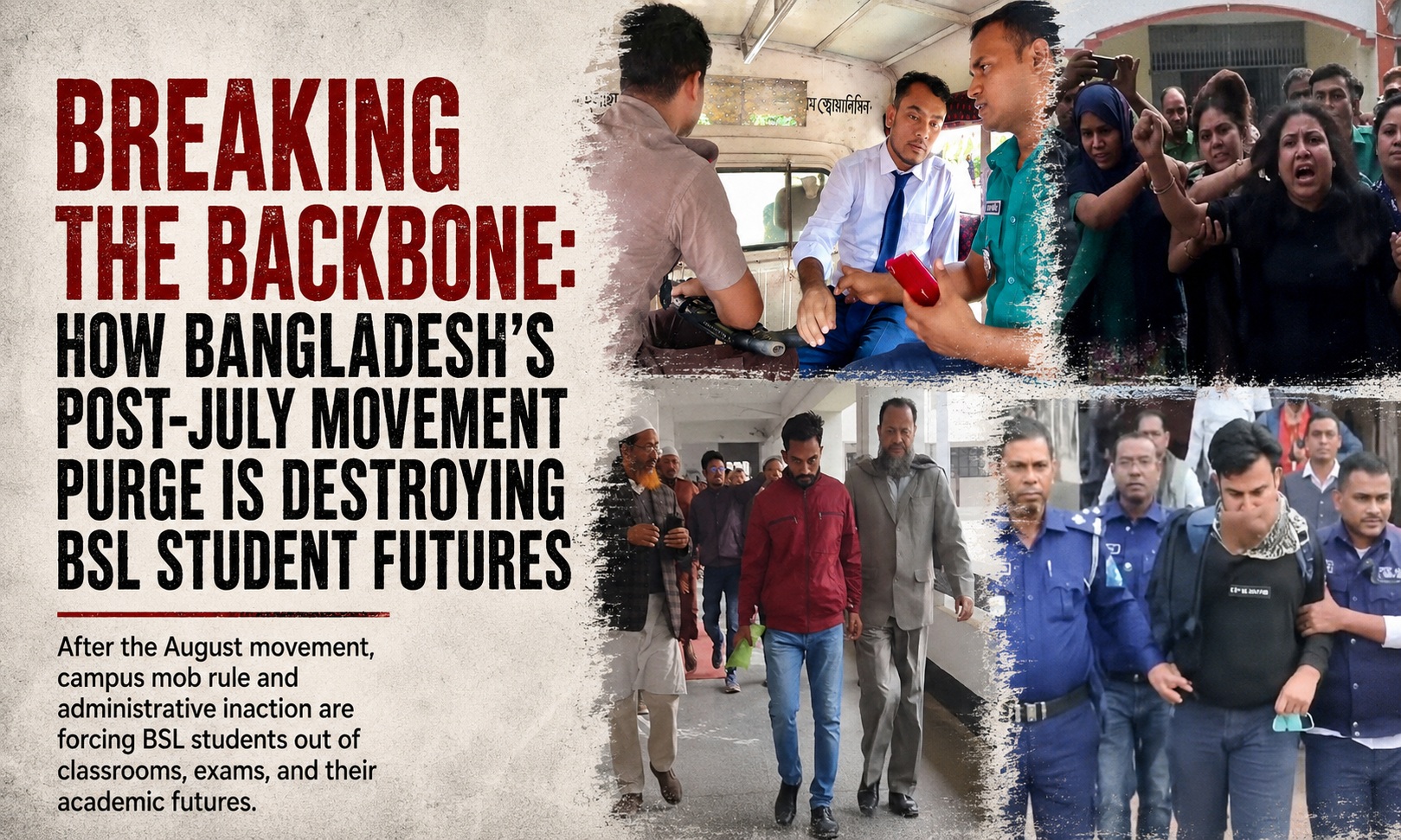
After the August movement, campus mob rule and administrative inaction are forcing BSL students out of classrooms, exams, and their academic futures.
In the aftermath of what has been romanticized as Bangladesh’s “Student Movement” on August 5, 2024, a dark reality has unfolded on the country’s campuses. The academic futures of thousands of students affiliated with the Bangladesh Students League (BSL), the student wing of the Awami League, have been systematically dismantled. Not through fair judicial processes, but through mob intimidation, arbitrary expulsions, arrests, and an atmosphere of raw fear engineered by supporters of the Yunus-led interim government, the National Citizen Party (NCP), Jamaat – Shibir and the BNP.
Academic Future Uncertain for Chhatra League Leaders and Activists
This is not justice. It is collective punishment that risks sacrificing an entire generation on the altar of political vendetta. While the world applauds Bangladesh’s so-called democratic “reset,” thousands of young people are being denied the fundamental right to education, simply for their political associations.
Following the fall of the Sheikh Hasina government, BSL students, leaders, activists, and even peripheral supporters found themselves branded as enemies of the new order. The organization was banned in October 2024 under anti-terrorism laws. What followed was a wave of reprisals that made campuses no-go zones for anyone with even tenuous BSL links.
How the Dreams and Aspirations of Bangladeshi Students Have Been Crushed
Reports from public universities paint a harrowing picture. Students who dared to return for exams or classes faced immediate hostility. One BSL-affiliated student, speaking anonymously to BBC Bangla, described attempting to sit for an exam only to be attacked, leading to arrest and 27 days in jail on dubious charges. She has not returned to campus since. Her education remains in limbo nearly a year and a half later.
This is not an isolated incident. Dhaka University issued show-cause notices to 403 students, predominantly BSL members, over alleged involvement in July 2024 events. Jahangirnagar University expelled over 100 BSL students, with some reports citing up to 289. Similar mass expulsions and suspensions occurred at SUST, Chittagong University, and others. Many were barred from campus entirely, their certificates revoked or withheld.
Classes and Exams Suspended for Banned Chhatra League Members at Universities

Even students with zero formal charges or disciplinary records live in constant terror, driven into academic exile by a complete collapse of institutional authority. Across major institutions like Dhaka, Rajshahi, and Chittagong universities, administrations have capitulated to vigilante demands, allowing hostile student groups to issue decrees branding BSL affiliates "unwelcome" in classrooms and exam halls. When targeted students plead for security to attend exams, department chairs offer a shameful, consistent response: "We cannot guarantee your safety. Do not return."
Former Chhatra League Convener at Comilla University Assaulted While Arriving for an Exam
By refusing protection and enforcing this "unofficial expulsion," university officials have surrendered campus charters to mob rule. Facing constant threats of mob lynchings, police harassment, and physical assault, thousands of students remain barred from their education solely over perceived political affiliation, with academic institutions actively facilitating vigilante detentions.

Exam Script of Chhatra League Member Cancelled
Two BSL leaders held while taking exams at RU
Expelled 20+, suspended 17+ BSL students
Chittagong University Expels 84 BSL Students
The post-July interim administration and subsequent BNP-influenced administration have failed spectacularly to uphold the rule of law, opting instead to preside over and actively enable a system where vigilante "justice" replaces institutional accountability. Across Bangladesh, students face a threefold barrier of terror:
The cancellation of exam papers, mob attacks inside test centers, and arbitrary detentions reveal a clear pattern: this is not a program of democratic reform, but an orchestrated campaign of political persecution.
Can a civilized nation treat its own students this way? In Bangladesh today, the answer appears to be yes. The same voices that decried quota discrimination and authoritarianism during the July movement have unleashed a new form of authoritarianism, one that punishes collective guilt without evidence or proportionality.
The consequences extend far beyond individual tragedies. Education is the backbone of any nation. By breaking it for thousands of young Bangladeshis, many of whom may bear no direct responsibility for July events, the previous Yunus interim government and the BNP-led administration are fracturing the country’s future. A generation is being radicalized by exclusion, deprived of skills, and pushed toward despair or exile. This is not transitional justice; it is educational sabotage with long-term national repercussions.
Article 26 of the Universal Declaration of Human Rights explicitly mandates that higher education shall be equally accessible to all on the basis of merit. Furthermore, the International Covenant on Economic, Social and Cultural Rights (ICESCR), to which Bangladesh is a state party, prohibits discrimination in education based on political opinion. The current practices in Bangladesh represent an explicit, ongoing violation of international law.
Can an international community that claims to value democratic governance, human rights, and rule of law remain silent while an entire generation of students is politically purged from higher education? When a state allows mob vengeance to dictate who may sit in a classroom and who may earn a degree, it surrenders its claim to civilized governance.





This work is copyrighted and authorized by the Bangladesh Awami League. You may download, display, print and re-produce this material in unaltered form only (retaining this notice)for your personal, non-commercial use or use within your organization.
