3433
Published on April 30, 2026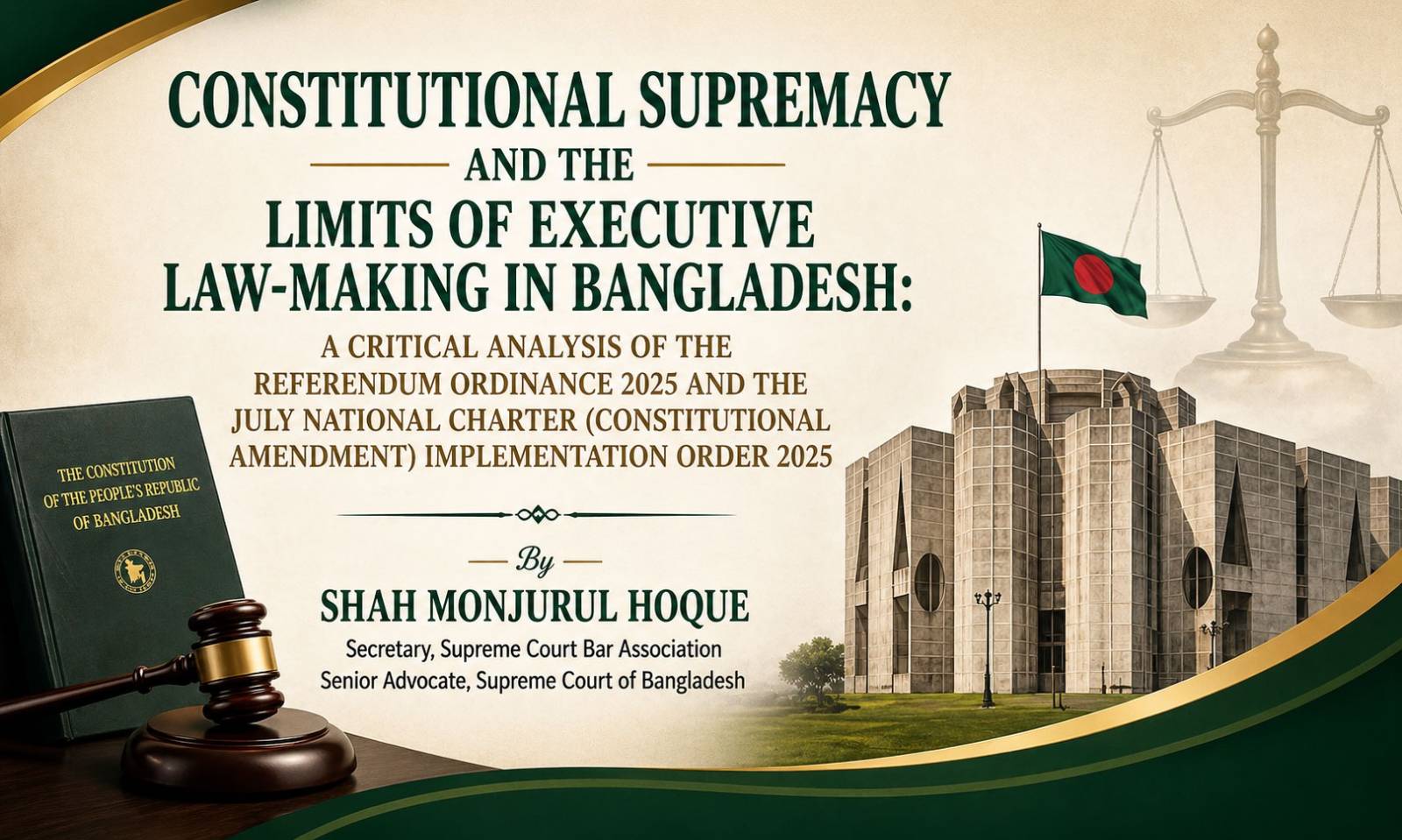
The Constitution of the People’s Republic of Bangladesh establishes a rigid constitutional framework in which all organs of the State must operate within clearly demarcated limits. Article 7 declares the Constitution to be the supreme law of the Republic and mandates that any law inconsistent with it shall, to the extent of such inconsistency, be void. This constitutional supremacy ensures that no organ of the State—whether legislative, executive, or judicial—may exercise power beyond the authority conferred by the Constitution.
The constitutional architecture of Bangladesh carefully allocates powers among the legislature, the executive, and the judiciary. Within this structure, the authority to amend the Constitution is vested exclusively in Parliament and is subject to the procedural safeguards prescribed under Article 142.
Against this backdrop, the promulgation of the Referendum Ordinance 2025 and the July National Charter (Constitutional Amendment) Implementation Order 2025 has generated profound constitutional controversy. These instruments attempt to introduce sweeping constitutional reforms through a referendum mechanism and through executive directives purporting to bind the future Parliament. Accordingly fundamental issues have arisen relating to the separation of powers, constitutional amendment procedure, the limits of ordinance-making power, and the inviolability of the basic structure of the Constitution.
The Constitution establishes a parliamentary form of government characterized by supremacy of the Constitution (Article 7), representative parliamentary democracy, separation of powers, independence of the judiciary and rule of law. The Supreme Court has repeatedly emphasized that all State organs derive their authority from the Constitution and must operate within its limits. In Anwar Hossain Chowdhury v Bangladesh 41 DLR (AD) 165 the Appellate Division recognized that the Constitution embodies fundamental structural principles which cannot be destroyed even through constitutional amendment. Thus, any attempt to alter the constitutional structure must conform strictly to the procedures prescribed by the Constitution.
The Referendum Ordinance 2025 purports to introduce a referendum mechanism for approving the July National Charter and various proposals for constitutional reform.
Section 3 of the Ordinance and the Schedule thereto provide that the electorate shall be asked a composite question consisting of four sub-questions. These sub-questions relate to sweeping constitutional reforms affecting core constitutional institutions. The reforms proposed include: (a) reconstitution of constitutional institutions during elections, (b) introduction of a bicameral Parliament, (c) structural changes to the executive and parliamentary system and (d) binding obligations upon political parties and the future Parliament to implement thirty constitutional reforms. The cumulative effect of these proposals is nothing less than a fundamental restructuring of the constitutional order affecting basic structure of the constitution.
Sub-question (a) of the referendum provides that the caretaker government, the Election Commission and other constitutional institutions during the election period shall be constituted in accordance with the July Charter. However, the Constitution already contains detailed provisions regarding the Election Commission under Articles 118–126. The Election Commission is a constitutionally entrenched body whose composition, powers, and functions are determined by the Constitution and by legislation enacted by Parliament. Any alteration to the structure or composition of the Election Commission must therefore be effected through constitutional amendment under Article 142. By proposing to reconstitute the Election Commission through a referendum mechanism, the Ordinance bypasses the constitutional amendment procedure and thereby undermines the constitutional framework governing electoral institutions.
Sub-question (b) proposes to transform the unicameral Parliament into a bicameral legislature by creating an Upper House consisting of 100 members. This proposal directly conflicts with Article 65, which provides that there shall be one Parliament for Bangladesh consisting of 300 members elected from territorial constituencies together with reserved seats for women. The introduction of a bicameral legislature represents a fundamental structural transformation of the constitutional framework. Such a transformation can only be achieved through constitutional amendment in accordance with Article 142. The attempt to introduce a bicameral system through referendum therefore constitutes a clear circumvention of the constitutional amendment procedure.
The referendum proposals also include increasing the reserved seats for women in Parliament from 50 to 100. The number of reserved seats for women is specifically provided in Article 65(3) of the Constitution. Any change to this provision necessarily requires constitutional amendment. Similarly, the proposal to require the Deputy Speaker to be selected from the opposition affects Article 74, which governs the election of the Speaker and Deputy Speaker. These reforms therefore directly interfere with constitutional provisions governing the composition and functioning of Parliament.
The referendum proposals further include fixing the tenure of the Prime Minister and altering the powers of the President. These proposals directly implicate several
constitutional provisions, including: Article 57 (tenure of the Prime Minister) AND Articles 48–54 (powers and functions of the President). Any alteration to these provisions would fundamentally affect the balance of power between the executive and the legislature. Such structural changes can only be achieved through constitutional amendment.
Perhaps the most constitutionally problematic feature of the referendum framework is the attempt to bind the future 13th Parliament to implement thirty constitutional reforms agreed upon in the July National Charter. This provision effectively pre-determines constitutional amendments and compels the future Parliament to enact them. Such an approach is inconsistent with the principle of parliamentary sovereignty within the constitutional framework. Parliament cannot be compelled by an executive instrument to enact constitutional amendments. The Constitution confers upon Parliament the discretion to determine whether and how constitutional amendments should be enacted.
The impugned Referendum Ordinance 2025 was promulgated under Article 93 of the Constitution. Article 93 empowers the President to promulgate Ordinances when Parliament stands dissolved or is not in session, provided that immediate action is necessary. However, Article 93 contains explicit limitations. Notably, it provides that an Ordinance cannot make any provision: which could not lawfully be made by Act of Parliament, or for altering or repealing any provision of the Constitution. Thus, the Constitution itself expressly prohibits the use of ordinance-making power for constitutional amendment. The Referendum Ordinance 2025 attempts to introduce structural constitutional reforms, including the creation of a bicameral legislature, reconstitution of constitutional institutions, and modification of executive and parliamentary structures. Such measures clearly fall within the domain of constitutional amendment and therefore cannot be enacted through an Ordinance. Consequently, the Ordinance appears to violate the express prohibition contained in Article 93(1)(ii).
A central feature of the impugned legal framework is the proposed referendum mechanism. The electorate was asked to answer a composite question consisting of multiple sub-questions concerning constitutional reforms. However, the constitutional status of referendums in Bangladesh is highly contentious. Historically, the Constitution contained provisions relating to referendum within Article 142. Those provisions were removed by the Fifteenth Amendment to the Constitution in 2011. As a result, the Constitution presently contains no operative provision authorizing the holding of a referendum. Even assuming that judicial pronouncements have revived the concept of referendum in principle, the operationalization of such a mechanism would still require a constitutional amendment enacted in accordance with Article 142. Without such amendment, any referendum lacks constitutional foundation. Therefore, the attempt to restructure the Constitution through a referendum conducted under an executive ordinance appears inconsistent with the constitutional scheme.
The July National Charter (Constitutional Amendment) Implementation Order 2025 constitutes a further attempt to operationalize the referendum proposals. However, the Constitution does not confer upon the President any general power to promulgate an
―Implementation Order‖ for constitutional reform. The powers of the President are exhaustively enumerated in the Constitution, including: Articles 48, 49, 93, 133, 134, 141A, 141B, 141C and 147. None of these provisions authorizes the issuance of such an order. Therefore, the Implementation Order appears to have been issued without constitutional authority. Furthermore, the constitution having not vested any power upon the President to promulgate an Order, thus the Implementation Order 2025 is void and non-est in view of Article 7 of the Constitution.
The Implementation Order further introduces a new body described as the ―Constitution Amendment Council‖. Members of Parliament were purportedly required to take oath as members of this Council. However, the Constitution contains no provision establishing such a body. The oath of Members of Parliament is prescribed in the Third Schedule of the Constitution. There is no constitutional requirement for Members of Parliament to take any additional oath in connection with constitutional reform. The creation of such a body therefore lacks constitutional foundation.
The constitutional challenges raised in the Ordinance and Order also implicate the basic structure doctrine. In Anwar Hossain Chowdhury v Bangladesh, the Appellate Division held that Parliament cannot amend the Constitution in a manner that destroys its basic structure. The structural changes proposed by the referendum—including the introduction of a bicameral Parliament and alteration of executive authority—have the potential to fundamentally alter the constitutional framework. If such changes were introduced without adherence to the constitutional amendment procedure, they would violate the basic structure of the Constitution.
The Referendum Ordinance 2025 and the July National Charter (Constitutional Amendment) Implementation Order 2025 represent an unprecedented attempt to restructure the constitutional order of Bangladesh through executive action. These instruments introduce sweeping reforms affecting the structure of Parliament, the executive branch, constitutional institutions, and the constitutional amendment process itself. However, the Constitution clearly provides that any amendment must be enacted through Parliament in accordance with Article 142. The ordinance-making power under Article 93 cannot be used to alter constitutional provisions, and the Constitution does not authorize the issuance of presidential orders for constitutional reform. Accordingly, the impugned measures appear to be inconsistent with the Constitution and therefore void under Article 7 of the Constitution.
---
Reference:
The Referendum Ordinance 2025
The July National Charter (Constitution Reforms) Implementation Order 2025
Mr. Chowdhury Md. Redwan –E-Khuda vs. Bangladesh and others, Writ Petition No. 2541 of 2026 (High Court Division), which is pending adjudication.
Mr. Gazi Md. Mahbub Alam vs. Bangladesh and others, Writ Petition No. 2787 of 2026 (High Court Division), which is presently pending adjudication.
Bangladesh National Parliament Secretariat, Memo No. 11.00.0000,000,862.19.0001.26.26 dated February 6, 2026.
The Constitution of the People’s Republic of Bangladesh, art 7, 93, 142
M Mahmdul Islam, Constitutional Law of Bangladesh (3rd edn, Mullick Brothers 2012).
Anwar Hossain Chowdhury v Bangladesh 41 DLR (AD) 165
Kesavananda Bharati vs. State of Kerala AIR 1973 SC 1461
M. Moneruzzaman, ―Experts split on MPs’ 2nd oath legitimacy‖, The New Age, February 16, 2026,https://www.newagebd.net/post/country/291391/experts-split-on- mps-2nd-oath-legitimacy.
Writer: Shah Monjurul Hoque, Secretary, Supreme Court Bar Association, Senior Advocate, Supreme Court of Bangladesh














This work is copyrighted and authorized by the Bangladesh Awami League. You may download, display, print and re-produce this material in unaltered form only (retaining this notice)for your personal, non-commercial use or use within your organization.
