3668
Published on April 29, 2026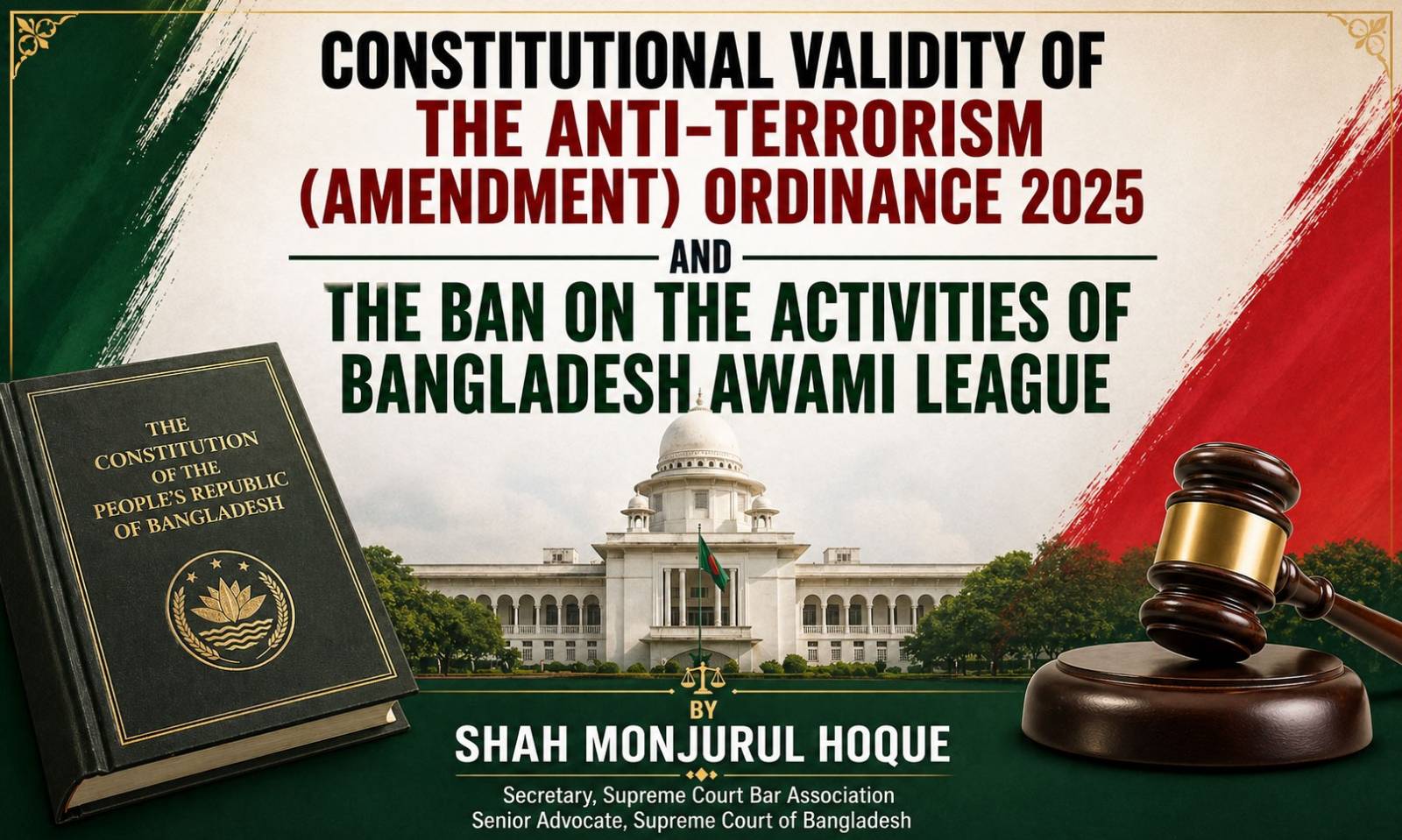
On 11 May 2025, the President promulgated the Anti-Terrorism (Amendment) Ordinance 2025, amending section 18 of the Anti-Terrorism Act 2009 by inserting the words “or may proscribe all the activities of the entity” after the phrase “may proscribe and enlist the entity in the schedule.” Immediately following the promulgation of the Ordinance, the Ministry of Home Affairs issued a Gazette Notification dated 12 May 2025 banning all activities of the Bangladesh Awami League and its affiliated, associate and fraternal organizations. The prohibition extended to publications, campaigns through mass, social and online media, meetings, processions, gatherings and conferences until the completion of trials of the leaders and activists of the party before the International Crimes Tribunal. On the same date, the Bangladesh Election Commission issued another Gazette notification suspending the registration of the Bangladesh Awami League.
The striking proximity between the promulgation of the Ordinance and the executive action banning the activities of the Awami League raises a serious constitutional question: whether the Ordinance was promulgated bona fide in exercise of constitutional power under Article 93 of the Constitution, or whether it was a colourable exercise of power designed solely to suppress the activities of a particular political party. This issue must be examined in light of constitutional provisions governing ordinance- making power, judicial precedents on the reviewability of presidential satisfaction, and the guarantees of fundamental rights contained in Articles 31, 38 and 39 of the Constitution of Bangladesh.
Ordinance-Making Power under the Constitution of Bangladesh
The power of ordinance-making by the President of Bangladesh is contained in Article 93 of the Constitution, which provides that when Parliament is dissolved or not in session, the President may promulgate an Ordinance if he is satisfied that circumstances exist which render immediate action necessary. The provision states that:
“If the President is satisfied that circumstances exist which render immediate action necessary, he may make and promulgate such Ordinances as the circumstances appear to him to require.”
Thus, three constitutional conditions are implicit in Article 93 (i) Parliament must not be in session, (ii) Circumstances must exist requiring immediate action, and (iii) the President must be satisfied of such necessity. An ordinance promulgated under Article 93 has the same force as an Act of Parliament, but it is essentially temporary legislation subject to parliamentary scrutiny. Under Article 93(2), it must be laid before Parliament at its first meeting and will cease to have effect after thirty days unless approved. Therefore, the ordinance-making power is exceptional and emergency in nature, intended only to meet urgent situations when the legislature cannot act.
Judicial Review of Presidential Satisfaction
Historically, the expression “if the President is satisfied” was interpreted as conferring subjective satisfaction beyond judicial scrutiny. However, this doctrine has been significantly diluted through judicial developments, particularly in Indian constitutional jurisprudence, which is highly persuasive in interpreting similar provisions in Bangladesh.
In the landmark decision in Barium Chemicals Case, the Supreme Court of India rejected the proposition that whenever a statute confers power upon an authority to act upon its satisfaction the courts are completely precluded from examining the exercise of such power. The Court held that where the statute makes the satisfaction of an authority a condition precedent for the exercise of power, it is open to the court to examine whether the circumstances required for the formation of that satisfaction actually existed. Thus the doctrine of subjective satisfaction was qualified by the principle that the existence of relevant circumstances is justiciable.
The principle was further developed in the celebrated decision of Cooper‟s Case. In that case the Supreme Court observed that when the Constitution or a statute requires satisfaction as a condition precedent for the exercise of power, the exercise of such power may be challenged by an aggrieved person on the ground that the satisfaction was not genuine or that it was mala fide. The Court recognised that although proving mala fides may be difficult, the possibility of judicial review cannot be excluded where the power has been exercised for an improper purpose.
The doctrine received further affirmation in the decision of the Supreme Court of India in the case of Wadhwa v State of Bihar where the repeated promulgation of ordinances by the executive was declared to be a fraud on the Constitution. The Court held that the ordinance-making power cannot be used to circumvent the legislative process or to achieve objectives that properly fall within the domain of Parliament. This line of reasoning clearly establishes that the satisfaction of the President in promulgating an ordinance is not beyond judicial scrutiny.
Application of the Doctrine in Bangladesh
The constitutional provision in Article 93 of the Constitution of Bangladesh is almost identical to Article 123 of the Indian Constitution. Consequently, Indian jurisprudence is highly persuasive. Bangladeshi courts have also recognized that ordinance-making power is subject to judicial scrutiny. In case of Idrisur Rahman and Syed Pirzada Syed Shariatullah, it was acknowledged that an ordinance may be challenged if it is mala fide, colourable or inconsistent with constitutional limitations. Thus, the President’s satisfaction is not immune from judicial review.
Ordinance as Colorable Exercise of Power
When the facts surrounding the Anti-Terrorism (Amendment) Ordinance 2025 are examined in this legal context, the inference of mala fide exercise of power becomes difficult to avoid. The amendment introduced a new authority enabling the government to proscribe all activities of an entity. Within a day of the promulgation of the Ordinance this newly created power was invoked to ban all activities of the Bangladesh Awami League and its associated organizations. The immediate exercise of the power against a specific political party strongly indicates that the amendment was enacted with a predetermined objective. A law enacted not for the general purpose for which legislative power exists but for the purpose of targeting a particular entity constitutes a colourable exercise of power. The constitutional doctrine of colourable legislation rests on the principle that what cannot be done directly cannot be done indirectly. Here the amendment introduced an extraordinary power to proscribe all activities of an entity, and this power was instantly exercised against a specific political party. Such circumstances raise a serious inference that the ordinance was not promulgated to combat terrorism generally but rather to achieve a targeted political outcome.
Unguided Discretion under Section 18
Section 18 of the Anti-Terrorism Act, as amended by the Ordinance, confers wide and unguided discretion upon the Government to ban the activities of an entity merely on the basis of its own opinion. The provision does not prescribe objective criteria for banning activities. It does not provide any procedural safeguard; does not require prior notice or hearing and does not provide for post-decisional review. Such unfettered power is inconsistent with the doctrine of substantive and procedural reasonableness, which forms part of Article 31 of the Constitution guaranteeing protection of law. A law conferring arbitrary power without safeguards is liable to be declared ultra vires the Constitution.
Violation of Freedom of Association
Article 38 of the Constitution guarantees the freedom of association subject only to reasonable restrictions imposed by law. The Constitution allows restrictions only if the association destroys religious or communal harmony, promotes discrimination, organises terrorist or militant activities, or its formation and objects are inconsistent with the Constitution. The Bangladesh Awami League, founded on 23 June 1949, is the oldest political party in the country and played a historic role in the Liberation War of 1971 under the leadership of Bangabandhu Sheikh Mujibur Rahman. For decades the party has participated in democratic elections and formed governments through the electoral process. Electoral statistics demonstrate its substantial public support:
1991 — 30.08% vote share
1996 — 37.44%
2001 — 40.13%
2008 — 48.04%
2014 — 72.14% (BNP boycott)
2018 — 74.96%
2024 — 224 parliamentary seats
These figures demonstrate that tens of millions of citizens support the party. The banning of all activities of such a political party through a simple executive notification effectively suppresses the constitutional rights of a large segment of the population. Thus the restriction is manifestly disproportionate and unreasonable, violating Article 38 of the constitution.
Violation of Freedom of Speech and Expression
Article 39 of the Constitution guarantees freedom of speech and expression and freedom of the press, subject to reasonable restrictions. The government notification prohibits: publications, media campaigns, social media activities, meetings and processions. Such sweeping restrictions effectively impose a complete ban on political expression of members and supporters of the Awami League. Restrictions that extinguish the very essence of a fundamental right cannot be considered reasonable restrictions within the meaning of Article 39 of the constitution.
Consequences if the Ordinance Ceases to Have Effect
Article 93 (2) provides that an ordinance must be laid before Parliament at its first sitting and will cease to have effect after thirty days unless approved. If (i) it is not laid before Parliament, (ii) Parliament disapproves it, or (iii) it is repealed earlier, then the ordinance ceases to have effect. However, as recognized in State of Orissa v Bhupendra Kumar Bose and T. Venkata Reddy v State of Andhra Pradesh, an ordinance that ceases to operate is not void ab initio. Like other temporary laws, it is treated as valid during the period of its operation, except for past and closed transactions. Nevertheless, actions taken under an ordinance may still be challenged if the ordinance itself is unconstitutional.
Conclusion
The Anti-Terrorism (Amendment) Ordinance 2025 raises profound constitutional concerns. Firstly, the timing and circumstances of its promulgation strongly suggest mala fide exercise of power, indicating that the ordinance was enacted with the predetermined objective of banning the activities of the Bangladesh Awami League. Secondly, the amendment confers unguided and arbitrary discretion upon the executive without procedural safeguards, rendering it inconsistent with the guarantees of due process under Article 31 of the constitution. Thirdly, the sweeping prohibition on the activities of the Awami League constitutes an unreasonable restriction on the freedoms of association and expression guaranteed under Articles 38 and 39 of the Constitution. Finally, given the historic role of the Awami League in the political development of Bangladesh and its substantial democratic support, banning its activities through executive notification represents a disproportionate and constitutionally impermissible intrusion into the democratic rights of millions of citizens.
For these reasons, the Anti-Terrorism (Amendment) Ordinance 2025 and the subsequent notifications banning the activities and suspending the registration of the Bangladesh Awami League cannot be sustained in law and are liable to be declared unconstitutional
---
Bibliography
Anti-Terrorism Act, 2009, s 18 (1).
Anti-Terrorism (Amendment) Ordinance 2025, s 2.
The words “or may proscribe all the activities of the entity” was inserted after the words “may proscribe and enlist the entity in the schedule” in section 18 (1) of the Anti-Terrorism Act, 2009 by Anti-Terrorism (Amendment) Ordinance 2025.
Ministry of Home Affairs, SRO No. 137-Law/2025, Bangladesh Gazette, Extraordinary, dated 12 May 2025
Bangladesh Election Commission, Memo No. 17.00.0000.025.50.023.12-124, Bangladesh Gazette, Extraordinary, dated 12 May 2025
The Constitution of the People’s Republic of Bangladesh, art 93, 31, 38 and 39.
M Mahmdul Islam, Constitutional Law of Bangladesh (3rd edn, Mullick Brothers 2012).
Acharya Dr. Durga Dus Basu, Commentary on the Constitution of India (8th edn, Lexis Nexis Butterworths Wadhwa 2008).
Barium Chemicals v. Company Law Board, AIR 1967 SC 295.
Cooper v. Union of India, AIR 1970 SC 564.
Wadhwa v. State of Bihar, AIR 1987 SC 579.
Idrisur Rahman v. Bangladesh, (2008) 60 DLR 714.
Syed Pirzada Syed Shariatullah v. Bangladesh, (2009) 61 DLR 503.
State of Orissa v Bhupendra Kumar Bose, AIR 1962 SC 945.
Venkata Reddy v. State of Andhra Pradesh, AIR 1985 SC 724.
Mohammad Al Masum Molla, “Ban on Awami League and Future Action”, The Daily Star, May 12, 2025, https://www.thedailystar.net/opinion/views/the-street- view/news/ban-awami-league-and-future-actions-3892206.
David Bargman, “The risks of banning Awami League activities”, Prothom Alo English, 15 May 2025, https://en.prothomalo.com/opinion/op-ed/lrm006wxhu.
Raji Krishna, “Ban on Awami League Will Have Consequence”, The Citizen, May 30, 2025, https://www.thecitizen.in/in-depth/ban-on-awami-league-will-have- consequences-1146720.
"Elections in Bangladesh‟ Wikipedia https://en.wikipedia.org/wiki/Elections_in_Bangladesh, accessed 6 March 2026.
---
Writer: Shah Monjurul Hoque, Secretary, Supreme Court Bar Association and Senior Advocate, Supreme Court of Bangladesh
Shah Monjurul Hoque
Secretary, Supreme Court Bar Association
Senior Advocate, Supreme Court of Bangladesh














This work is copyrighted and authorized by the Bangladesh Awami League. You may download, display, print and re-produce this material in unaltered form only (retaining this notice)for your personal, non-commercial use or use within your organization.
