3495
Published on January 20, 2026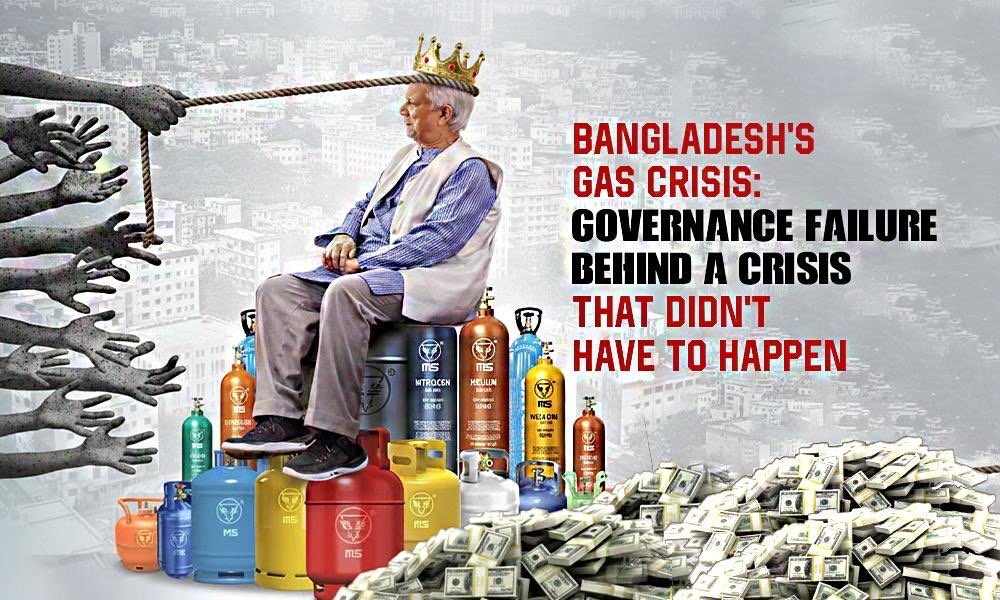
What Bangladesh is facing today is not a sudden shock, not an unavoidable global spillover, and not a mystery of supply. It is a failure of governance, plain and undeniable, yet another example of misrule under dr yunus. The gas crisis unfolding across the country is a direct outcome of state neglect under the illegal Yunus administration, which has allowed a critical public utility to drift into chaos while hiding behind the language of “reform.”
A Deep Energy Crisis Looms Over the Country
This crisis did not emerge overnight. Bangladesh has faced far worse global energy disruptions in recent years and still managed to prevent a system-wide collapse. Today, however, gas shortages persist even when consumers are willing to pay, LPG cylinders vanish from markets despite ongoing imports, and supply chains remain visibly unmanaged. These are not symptoms of scarcity; they are symptoms of administrative paralysis.
At its core, this is not a resource failure but a leadership failure. Under Sheikh Hasina’s government, scarcity was anticipated and managed through LNG imports, LPG and CNG continuity, subsidies, and active state intervention. Under Yunus, execution has been abandoned. While the government continues to speak loudly about reform, it has failed at the most basic task of governance: keeping the country running. The result is a deepening gas crisis that exposes how a manageable challenge was turned into a national emergency, one that did not have to happen.
The gas crisis has moved beyond short-term disruption and entered a phase of systemic failure. Despite existing infrastructure and import channels, the Yunus administration has failed to manage supply, regulate markets, or ensure continuity, turning energy access into daily uncertainty.
Domestic pipeline gas supply has become erratic, with prolonged and unannounced outages across urban areas, particularly in Dhaka
LPG availability is unstable despite ongoing imports, marked by sudden shortages and sharp price volatility due to weak regulatory oversight
CNG supply disruptions have forced stations to shut down or operate intermittently, undermining a previously stable urban transport fuel system
Industrial gas allocation has been reduced or rationed, forcing factories to operate below capacity or suspend production
Major cities now face routine gas interruptions, affecting households and commercial activity alike.
Small businesses, manufacturing units, and the garment sector are absorbing direct financial losses from halted operations and rising energy costs
Transport services are destabilized by unreliable CNG supply, increasing commuting costs, and reducing service availability. newsbangla24.com
By 2024, Bangladesh entered a period of heightened energy vulnerability that required decisive fiscal and administrative intervention. Instead, the interim Yunus government allowed existing stress factors to compound into a full-scale gas supply breakdown. The result has been a crisis driven not by sudden depletion of resources, but by delayed decisions, weakened execution capacity, and worsening macroeconomic constraints.
No Clear Solution in Sight as LPG Crisis Continues
Bangladesh’s gas balance deteriorated sharply during 2024–2026:
Domestic gas production in 2024–2025 remained largely flat at approximately 2,300–2,400 mmcfd, while effective demand exceeded 3,500 mmcfd, leaving a structural deficit of over 1,000 mmcfd. dhakatribune.com
LNG, which had functioned as the primary balancing mechanism since 2018, became increasingly constrained. In 2024, LNG accounted for roughly 27–30% of gas supply during peak months, but volumes declined in 2025–2026 due to procurement delays and financing shortfalls. tbsnews.net
Unlike earlier periods, no emergency stabilization framework was activated despite visible supply stress, leading to simultaneous disruption across pipeline gas, LPG, and CNG systems.
Foreign exchange capacity has also emerged as a decisive limiting factor, shaping procurement decisions and restricting the government’s ability to stabilize gas supply.
By late 2024, Bangladesh’s gross foreign exchange reserves had fallen to the USD 20–22 billion range, and usable reserves declined further through 2025, restricting the government’s ability to finance LNG spot cargoes. tbsnews.net
Each LNG cargo requires USD 60–80 million upfront, and the interim government faced increasing difficulty securing dollars amid slowing export growth, reduced industrial output, and persistent balance-of-payments pressure. bdvortex.com
As a result, LNG procurement became irregular, storage planning was abandoned, and supply buffers, critical during demand spikes, were not rebuilt through 2025–2026.
Key Factors Driving the Gas Crisis
Strategic energy planning also stalled during this period.
No new offshore or deep-sea gas exploration initiatives were launched in 2024–2026, despite Bangladesh’s long-standing maritime access and previously identified prospects.
Energy diversification pathways,coal-based baseload continuity, nuclear integration, and alternative energy scaling saw no meaningful acceleration, increasing overreliance on an already strained gas system.
Policy focus shifted toward broad reform narratives, while execution timelines, investment commitments, and operational benchmarks remained absent.
Market governance failures further intensified the crisis.
LPG imports continued through 2024–2026, yet retail markets experienced repeated shortages and price volatility, indicating regulatory and enforcement failure rather than physical unavailability.
Weak oversight enabled hoarding, delayed distribution, and speculative pricing, particularly during peak demand periods.
Confidence among energy importers, distributors, and operators deteriorated as payment predictability, policy clarity, and administrative coordination weakened.
GAS CRISIS: A system full of holes
Taken together, developments between 2024 and 2026 show that Bangladesh’s gas crisis is the product of governance breakdown under the interim administration. The Hasina government had previously absorbed global energy shocks through subsidies, LNG financing, and supply diversification.
In contrast, the Yunus government inherited a fragile but functional system and allowed it to deteriorate amid fiscal stress, foreign exchange shortages, and prolonged policy inaction, turning a manageable energy challenge into a nationwide emergency.
Before the supply breakdown that emerged in 2024–2026, Bangladesh’s energy management operated with strategic foresight and active state intervention, ensuring continuity through global shocks. Under Sheikh Hasina, energy security was treated as a core governance priority rather than a market gamble.
The Sheikh Hasina government secured long-term LNG import frameworks, including multi-year agreements with Qatar. Under a government-to-government LNG Sales and Purchase Agreement (SPA), Bangladesh imports roughly 40 LNG cargoes annually from Qatar, providing a stable baseload supply and reducing exposure to volatile spot markets. thedailystar.net
Long-term LNG imports were later broadened to include additional import capacity from Oman, reflecting diversification beyond a single source. newsbangla24.com
Between 2018 and 2024, the Hasina government allocated significant fiscal support to LNG imports, reporting subsidies totaling approximately Tk 262.15 billion over six years, ensuring that import costs did not translate directly into unaffordable prices for consumers and industry. www.thebangladeshexpress.com
Policy and financial support mechanisms were also extended to LPG supply to maintain availability as domestic gas production declined and demand shifted.
These interventions were coupled with broader energy security strategies:
Expanded coal imports and allocation helped keep power plants running during periods of gas pressure, avoiding widespread electricity outages.
The government advanced infrastructure for LNG import, including agreements that increase long-term cargo volumes from Qatar and additional spot-market purchases to meet demand during peak seasons.
Crucially, decisions were implemented through institutional channels, the Ministry of Power, Energy, and Mineral Resources, Petrobangla, and relevant regulatory bodies, ensuring continuity and execution rather than ad-hoc policy shifts. This institutional execution under Hasina contrasts with the policy drift observed in 2024–2026, when fiscal constraints and administrative inaction contributed to supply instability despite existing import agreements.
|
Dimension |
Sheikh Hasina Government |
Yunus Government |
|
Crisis Recognition |
Early & realistic |
Delayed & dismissive |
|
LNG Strategy |
Contracts + subsidies |
Confusion & inertia |
|
LPG & CNG |
Supply stabilization |
Scarcity & volatility |
|
Long-Term Vision |
Nuclear, coal, exploration |
No visible roadmap |
|
Governance Style |
Policy-driven |
Rhetoric-driven |
From the very beginning, the Yunus government framed itself as a “reform” administration. Yet as Bangladesh slides into a deepening gas crisis, now spilling into industrial slowdown, inflationary pressure, and broader economic stress, there is no evidence that this reform agenda ever translated into action in the energy sector.
Since taking office in 2024, the government has introduced no concrete reform in gas procurement, no restructuring of LNG financing, no stabilization mechanism for LPG and CNG markets, and no initiative to expand domestic gas exploration. Supply planning remained ad hoc, storage buffers were neglected, and market oversight weakened, precisely as demand and vulnerability increased.
In practice, “reform” became a slogan used to mask delay. While the government spoke of long-term transformation, it failed at the immediate task of governance: securing energy, managing risk, and preventing system breakdown. The current gas crisis is not a transition cost of reform; it is the cost of having none.






This work is copyrighted and authorized by the Bangladesh Awami League. You may download, display, print and re-produce this material in unaltered form only (retaining this notice)for your personal, non-commercial use or use within your organization.
